

Butter and sugar cream into a pale, billowy mass as granules soften and the mixture shifts from matte to glossy. The pressed dough flattens into a uniform sheet that turns from pliant to brittle around the 20-minute mark in a 9×13 pan.
This recipe’s inputs — 1/2 cup sugar, 1 1/4 cups unsalted butter (softened), 2 1/4 cups all-purpose flour, 28 ounces sweetened condensed milk, 6 ounces dark chocolate (60% cacao), Sea salt (for garnish) — set the staging for three distinct layers whose textures interact during bake and cool. The shortbread, caramel, and chocolate each follow a different thermal and moisture trajectory, and the sequence of pressing and layering produces the final bar geometry visible after slicing; the structural parallels are similar to those in almond flour sugar cookie bars where a compact crumb is established before toppings are added.
Creaming dynamics and the shortbread sheet
The creaming of 1/2 cup sugar with 1 1/4 cups unsalted butter (softened) is the mechanical step responsible for entraining air and creating a spreadable matrix. In this formulation the relatively low sugar-to-fat ratio confines the volume increase: sugar crystals abrade softened butter, creating microscopic air pockets while concurrently dispersing fat. The result is a paste that will accept 2 1/4 cups all-purpose flour without becoming greasy; that balance determines whether the dough can be pressed thinly across a 9×13-inch base.
Within the creamed mass, particle dispersion of sugar and the continuity of the fat phase set the shortbread’s ultimate fracture pattern. When egg yolk is added, it contributes a thin protein network and lecithin-rich emulsifiers that modestly reduce friability, making the pressed dough cohesive enough to compact into a single sheet rather than crumble. This cohesion is important for the pressing step: a loosely aggregated dough won’t hold a uniform thickness, and variable thickness yields uneven baking and caramel absorption at the interface.
Egg yolk binding and interface cohesion in a large pan
The single egg yolk in the mixing stage acts primarily as an interstitial binder for this sheet dough rather than as a leavener. Its proteins coagulate during the 20-minute bake, forming a fine network across the shortbread that minimizes large fissures when the hot caramel is poured. In a 9×13 format the surface area is high relative to volume, so the yolk’s binding effect is distributed thinly; this distribution produces a dense, slightly tender shortbread rather than a cake-like crumb.
Because the dough is pressed into the bottom of the prepared pan, uniform pressure influences thickness more than kneading would. The yolk’s emulsifying components smooth the dough surface, reducing microvoids that would otherwise trap molten caramel. The result is an interface that can resist immediate saturation, allowing the caramel to sit atop the shortbread for a brief period before migrating into pores, which controls the depth of caramel penetration and the shortbread’s final moisture gradient.
Flour incorporation and the low-moisture dough matrix
Gradually folding in 2 1/4 cups all-purpose flour and salt produces a soft dough that remains intentionally low in free water. The folding technique minimizes gluten development by limiting shear, preserving a crumble-prone network instead of an elastic one. In this formulation the flour’s starch fraction sets the matrix and the limited hydration means the shortbread relies on fat continuity for cohesion rather than an extensive gluten scaffold.
The low free-moisture content influences heat conduction during the 20-minute bake. Drier dough fragments transmit heat differently: surfaces brown more readily while the interior remains pale and brittle. That pale golden surface is a key visual indicator here because excessive browning would signal extended moisture loss and a harder bite, whereas under-baked shortbread will compress when the hot caramel is poured, risking doming or sinking.
Browning threshold at 350°F in a 9×13 tray
At Preheat oven to 350°F (175°C) and bake for about 20 minutes the shortbread crosses two concurrent thermal thresholds: protein set from the egg yolk and starch gelatinization from the flour. Because the layer is thin across a 9×13 pan, heat reaches the center rapidly and browning is concentrated at the edges where temperatures exceed average due to convection and radiation exposure.
Visual cues during this 20-minute window are specific: the surface transitions from pale matte to faintly golden and the edges firm first. These changes correspond to localized moisture evaporation and sugar-surface interactions. The global geometry of the pan also affects convection patterns — perimeter points brown faster — so pressing the dough evenly and keeping the pan orientation constant produce a consistent browning threshold across the sheet.
Condensed milk caramel viscosity and thickening kinetics
For the caramel layer the method calls to combine sweetened condensed milk, butter, and corn syrup in a saucepan over medium heat and stir until melted and thickened (about 5 minutes). The condensed milk’s concentrated sugar and milk solids establish a dense starting viscosity; when heated the Maillard-reactive proteins and sugars begin to darken, while water content reduces and the mixture thickens. Butter contributes both fat for sheen and emulsion stability, while corn syrup acts to suppress large sucrose crystallization, ensuring a smooth viscous pour.
Thickening in roughly five minutes at medium heat is a function of both water evaporation and the concentration of dissolved solids. The target viscosity for the pour is high enough to maintain a coherent layer but low enough to wet the shortbread surface and create contact; this balance determines whether the caramel sits as a discrete layer or infiltrates the shortbread pores. The condensed milk base produces a denser, more adhesive caramel than a traditional sugar-only caramel, and its high solids content expedites thickening without requiring hard-ball stages.
Thermal coupling when pouring hot caramel onto baked shortbread
Pouring hot caramel over the baked shortbread establishes a brief period of bidirectional heat transfer. The caramel remains hotter and more mobile, while the shortbread is cooler and brittle. At this moment the two layers exchange heat and moisture: the shortbread’s surface warms and solutes in the caramel can penetrate microvoids, while the caramel starts to cool and increase in viscosity upon contact.
This thermal coupling controls the degree of interlayer adhesion. If the shortbread is still too warm, the caramel may thin further and seep deeper, softening the base beyond the intended bite. Conversely, a sufficiently cooled shortbread supports the caramel, allowing it to set atop the sheet with a visible boundary. The method’s sequence — bake then pour — aims to reach a compromise where partial penetration occurs to bond layers but the majority of the caramel remains as a distinct, sliceable stratum.
Chocolate melt behavior and surface formation above caramel
Melt dark chocolate in a microwave-safe bowl; pour it over the caramel layer, spreading evenly. The chocolate is melted to a liquid state for ease of spreading, but without formal tempering the final surface sheen and snap derive from the chocolate’s cooling rate and the thinness of the layer. The thickness of 6 ounces of dark chocolate across a 9×13 spread determines crystallization speed; thinner films cool faster and form smaller crystal domains, giving a modest sheen even without seed tempering.
The interface between chocolate and caramel is governed by adhesion and residual surface sugars. Because the caramel retains some moisture and soluble sugars at its uppermost surface, the chocolate must be poured while still fluid to wet that layer and form a continuous film. As the chocolate cools, it encapsulates stray caramel peaks and, when chilled after room-temperature rest, forms a continuous brittle cap whose fracture properties depend on chocolate temper and layer thickness.
Sea salt as a surface modifier and slicing behavior
Sprinkling Sea salt (for garnish) across the warm chocolate introduces discrete, hard particles that punctuate the final surface. The salt crystals disrupt the chocolate film locally, offering both a visual contrast and a mechanical focal point for fracture propagation. Because the salt is granular and non-hygroscopic in the short term, it remains as discrete points that interact with cutting force during portioning.
Slicing after chilling in the fridge for about an hour yields bars whose fracture lines are influenced by the salt distribution and the layered stiffness contrast. The chocolate cap is brittle, the caramel is ductile, and the shortbread is friable; the combination requires a decisive slicing force to induce clean breaks. Salt placed near expected cut lines can facilitate a clean break by localizing stress, while large clusters of salt can cause tearing of the chocolate and attract caramel pull-away if unevenly distributed.
Chilling, settling, and portioning mechanics for uniform bars
Allow bars to cool at room temperature before chilling in the fridge for about an hour. During room-temperature rest the chocolate surface loses initial thermal gradients and the caramel continues slow moisture migration; chilling then accelerates the solidification of chocolate and raises the caramel’s yield strength. The timed chilling window is crucial: insufficient chill leaves a soft chocolate cap and gummy cuts, while overchilling creates adhesion differentials that can cause the caramel to fracture rather than shear cleanly.
Cutting into squares or bars to serve after chilling benefits from a steady slicing tool and a single direction cut per pass to minimize smearing. The layered construction dictates that blade contact first breaks the chocolate, then shears the caramel, and finally compresses and fractures the shortbread. Slight warming of blade between passes — by exposure to room air rather than heat application — reduces sticking without altering the bars’ internal structure.
Preparation steps
- Preheat oven to 350°F (175°C). Grease or line a 9×13-inch baking pan with parchment paper.
- In a mixing bowl, cream together softened butter and sugar until light and fluffy. Add egg yolk and mix well.
- Gradually fold in flour and salt until a soft dough forms. Press into the bottom of the prepared pan and bake for about 20 minutes or until golden brown.
- For the caramel layer, combine sweetened condensed milk, butter, and corn syrup in a saucepan over medium heat. Stir until melted and thickened (about 5 minutes), then pour over baked shortbread.
- Melt dark chocolate in a microwave-safe bowl; pour it over the caramel layer, spreading evenly. Sprinkle with sea salt.
- Allow bars to cool at room temperature before chilling in the fridge for about an hour. Cut into squares or bars to serve.
A related caramel-focused behavior appears in other layered bars where a viscous, milk-solid–based caramel is used; the interplay of sweetened condensed milk and heat in this recipe shares technique with some cheesecake-based bars such as caramel apple cheesecake bars, though the substrate and post-bake handling differ.
The finished bars present three settled layers: a firm pale shortbread sheet, a thick adhesive caramel, and a brittle dark chocolate cap dotted with salt. After the prescribed chill period the layers hold distinct textures and the bars retain their rectilinear form when sliced.
Print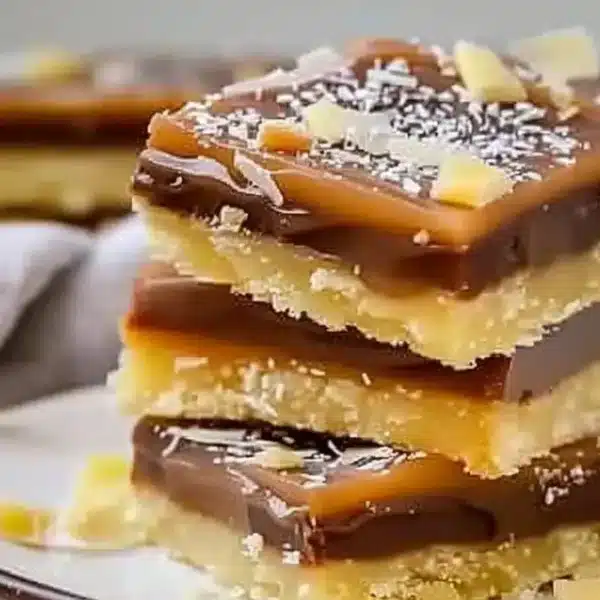
Millionaire Shortbread Bars
- Total Time: 40 minutes
- Yield: 16 servings 1x
- Diet: Vegetarian
Description
Delicious layered bars featuring a shortbread base, thick caramel filling, and a chocolate top, garnished with sea salt.
Ingredients
- 1/2 cup sugar
- 1 1/4 cups unsalted butter (softened)
- 1 egg yolk
- 2 1/4 cups all-purpose flour
- 1/4 teaspoon salt
- 28 ounces sweetened condensed milk
- 6 ounces dark chocolate (60% cacao)
- Sea salt (for garnish)
Instructions
- Preheat oven to 350°F (175°C). Grease or line a 9×13-inch baking pan with parchment paper.
- Cream together softened butter and sugar until light and fluffy. Add egg yolk and mix well.
- Gradually fold in flour and salt until a soft dough forms. Press into the bottom of the prepared pan and bake for about 20 minutes or until golden brown.
- For the caramel layer, combine sweetened condensed milk, butter, and corn syrup in a saucepan over medium heat. Stir until melted and thickened (about 5 minutes), then pour over baked shortbread.
- Melt dark chocolate in a microwave-safe bowl; pour it over the caramel layer, spreading evenly. Sprinkle with sea salt.
- Allow bars to cool at room temperature before chilling in the fridge for about an hour. Cut into squares or bars to serve.
Notes
Ensure the layers cool properly for distinct textures. Sea salt enhances flavor and presentation.
- Prep Time: 15 minutes
- Cook Time: 25 minutes
- Category: Dessert
- Method: Baking
- Cuisine: British
Nutrition
- Serving Size: 1 bar
- Calories: 320
- Sugar: 18g
- Sodium: 150mg
- Fat: 20g
- Saturated Fat: 12g
- Unsaturated Fat: 5g
- Trans Fat: 0g
- Carbohydrates: 35g
- Fiber: 1g
- Protein: 3g
- Cholesterol: 30mg