
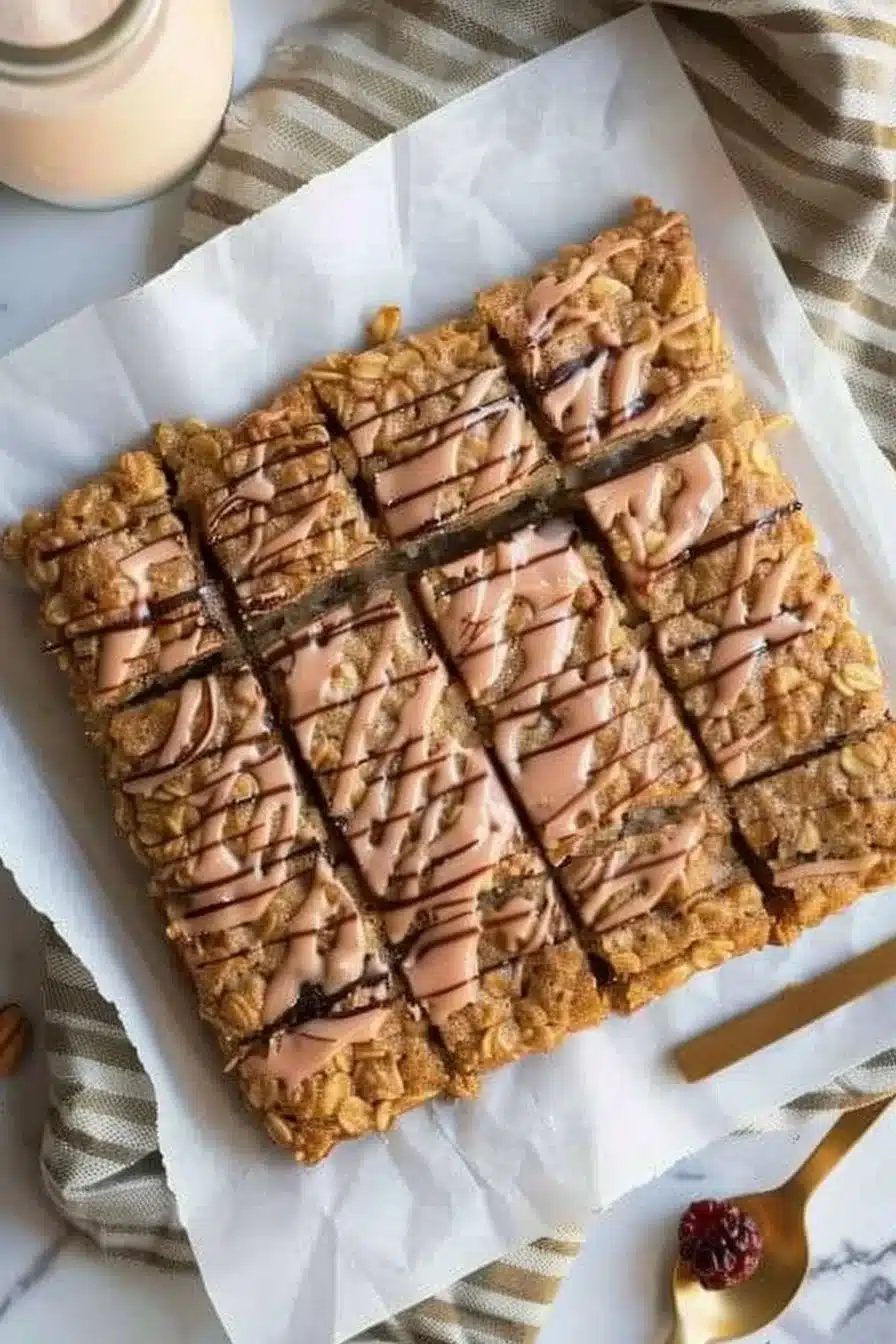
The batter changes from a viscous swirl of nut paste and sugar to a glossy, runny emulsion when eggs and milk are whisked in, and the surface tightens from glossy to matte as the bake progresses. The peanut aroma rises faintly during mixing and deepens at the oven edge where browning concentrates. In parallel, a nearby recipe for a peanut butter smoothie bowl demonstrates how the same base flavor behaves in liquid rather than baked matrices.
How peanut butter integrates into a single wet matrix
Peanut butter at ½ cup (125g) acts as both a lipid phase and a dispersed thickener in this recipe. When whisked with 2 large eggs, 2 cups (480mL) of milk, ¼ cup packed brown sugar (50g), 1 teaspoon vanilla and ¼ teaspoon kosher salt, the peanut butter breaks into smaller globules suspended within the aqueous phase. The eggs supply lecithin and proteins that surround oil droplets and create a temporary emulsion; the milk dilutes viscosity and permits more uniform distribution of peanut solids. In this specific formula the proportion of peanut butter to milk (125g to 480mL) results in a batter that is explicitly described as “runny” in the method, which indicates incomplete network formation of egg proteins prior to heat setting. That runniness is crucial here: it allows oats and protein powder to be dispersed without clumping, producing a homogeneous slurry that will gel mainly during baking rather than during mixing.
Sugar and salt shaping surface gloss and caramel cues
The ¼ cup of packed brown sugar carries both sucrose and molasses components that influence surface behavior during the 25–30 minute bake. Molasses increases hygroscopicity at the surface, which delays crust formation slightly relative to straight sucrose; however, the combination with the peanut fats encourages localized browning at the pan edges where heat transfer is fastest. The ¼ teaspoon kosher salt tightens the flavor matrix and modifies boiling point interactions at the immediate surface, subtly shifting how the brown-sugar moisture migrates outward. For this exact ratio and bake time, the expected visual response is a set, slightly darkened rim with a center that looks almost set or a little wet, because the sugar and fat concentrations slow moisture evaporation enough that the middle does not fully desiccate within the base bake window.
Oats hydrating within a runny batter
The 2 cups of old fashioned oats (170g) are whole-flake particles that hydrate primarily by absorbing the aqueous phase supplied by milk and eggs. In a runny batter, water and milk can penetrate oat flakes more uniformly compared with a thicker batter, producing more evenly swollen flakes by the end of the specified bake cycle. Hydration kinetics here are constrained by bake time: 25–30 minutes in an 8×8 pan provides enough latent heat and free water transfer to soften the oats substantially while leaving some discrete chew, which is why the method notes the center may remain slightly wet. The runny nature of the batter ensures oat flakes are dispersed rather than clumped together, so texture after baking is a combination of individual oat swell and a continuous protein-lipid matrix that binds them in place.
Protein powder’s role in viscosity and final set
The inclusion of ~⅓ cup protein powder (~35g) changes both pre-bake viscosity and post-bake network strength. Powdered protein particles absorb free liquid and can act as nucleation sites for gelation when heated in the presence of eggs and milk. In this recipe, the listed order—oats and protein powder folded into a runny emulsion—places protein particles among hydrated oat flakes rather than dominating the aqueous phase. That distribution reduces rapid thickening during mixing but contributes to a firmer crumb when the center is held in the oven for an additional five minutes. The specific mass of protein powder relative to oats and milk means it affects chew and cohesion noticeably in this baked matrix: increased protein creates a denser, less crumbly slice, while the stated amount preserves some softness.
Heat flow and edge-to-center set in an 8×8 pan
An 8×8 baking pan creates a shallow layer that encourages faster edge conduction and slower center heat penetration. With the batter poured into the prepared pan and baked at 350°F (177°C), the perimeter receives conductive heat from the metal walls, leading to earlier protein coagulation and localized fat migration. The instruction to bake 25–30 minutes or until the edges are set and firm and the center looks almost set or a little wet is optimized for this geometry and the batter’s runny state. Extending the bake by another five minutes increases center temperature sufficiently for additional egg-protein crosslinking and moisture evaporation, yielding a firmer baked oatmeal. For this composition, the thermal gradient is the primary determinant of the split between a set rim and a slightly yielding core.
Surface chemistry driving color and slight crust formation
On the surface, sugars, milk proteins, and peanut solids participate in Maillard and caramelization pathways within the 25–30 minute window at 350°F. The brown sugar’s molasses content promotes deeper color development than white sugar would in the same timeframe, and peanut solids contribute amino groups that participate in browning reactions. Because the batter contains both lactose from milk and sucrose from brown sugar, the surface develops a concentrated crust primarily at locations of faster moisture loss—usually toward the edges and any raised ridges. The method’s allowance for an additional five minutes to reach a fully set center will also intensify surface color, but given the specified proportions the surface typically remains moderately soft rather than forming a hard crust.
Cooling, resting, and the final slice mechanics
Allowing the baked pan to rest and cool for 5 minutes before slicing affects cohesion and moisture redistribution in predictable ways for this recipe. During that brief rest, temperatures in the center decline enough for residual egg proteins and starches to firm slightly without continuing significant water loss. The peanut butter and fats, still warm, reduce surface adhesion between the knife and slice, easing separation. However, the recipe’s explicit five-minute rest preserves a degree of moisture in the center, consistent with the “almost set or a little wet” description; slicing sooner can yield spreading, while waiting longer produces cleaner, firmer edges. The specified rest time is a balance between sufficient structural set for slicing and retention of a tender interior.
Toppings, surface tension, and post-bake adhesion
A drizzle of melted chocolate or extra peanut butter applied after cooling interacts with the finished surface differently depending on temperature and surface porosity. If applied immediately after the five-minute rest, melted chocolate will sink slightly into micro-pores created by escaping steam, anchoring to the surface and setting quickly as it cools. A warm smear of peanut butter will remain more malleable and integrate with the top layer where surfactants in the peanut spread align with residual oils. For this baked oatmeal specifically, the interplay between topping and base is governed by how much the center was left moist: a wetter center allows more downward migration of a liquid topping, while a firmer center retains toppings on the surface.
Storage behavior and simple reheating dynamics
Once fully cooled and sliced, the baked squares behave as a composite of hydrated oats, protein-fortified matrix, and dispersed fats. Stored in an airtight container, moisture migration continues slowly: the exterior will equilibrate with container humidity, potentially softening slightly over 24–48 hours. Reheating slices re-liquefies some fats and warms trapped water, temporarily restoring a tender mouthfeel; a short microwave burst or a low oven heat will reduce perceived staleness by reactivating the batter’s residual gelatinized starches. In this recipe, the initial runniness and moderate fat content mean slices tolerate brief reheating without drying out excessively, but extended high heat will drive further evaporation and a firmer chew.
Procedure follows the sequence below.
- Preheat oven to 350°F (177°C) and butter or use non-stick spray in an 8×8 baking pan. Set aside.
- In a medium to large bowl, add the peanut butter (½ cup/125g), brown sugar (¼ cup/50g), vanilla (1 teaspoon) and kosher salt (¼ teaspoon) and whisk together.
- Add the eggs (2 large) and whisk to combine. Then add the milk (2 cups/480mL) and whisk. The mixture is runny.
- Now add the old fashioned oats (2 cups/170g) and protein powder (? cup/~35g) and stir until combined. The batter is runny.
- Pour into the prepared baking pan and place in the preheated oven. Bake for 25-30 minutes or until the edges are set and firm and the center looks almost set or a little wet. If you prefer a firmer baked oatmeal, bake another five minutes or so until the center has fully set.
- Allow to rest and cool 5 minutes, then slice and serve. Can be topped with a drizzle of melted chocolate, peanut butter, or other toppings listed in the post.
A contrasting application of similar peanut flavors in a chilled, blended matrix appears mid-text in another entry, demonstrating the difference when the nut base is held fluid rather than baked: peanut butter banana smoothie bowl.
The finished squares display a set perimeter with a slightly yielding center when taken from the pan after the indicated bake and brief rest. Surfaces hold applied drizzles without immediate collapse, and the internal structure remains cohesive enough for clean slices after the prescribed five-minute cooling period.
Print
One Bowl Baked Peanut Butter Oatmeal
- Total Time: 40 minutes
- Yield: 8 servings 1x
- Diet: Vegetarian
Description
A delicious, easy-to-make baked oatmeal combining the rich flavor of peanut butter with wholesome oats, perfect for breakfast or a snack.
Ingredients
- ½ cup peanut butter (125g)
- ¼ cup packed brown sugar (50g)
- 1 teaspoon vanilla extract
- ¼ teaspoon kosher salt
- 2 large eggs
- 2 cups milk (480mL)
- 2 cups old fashioned oats (170g)
- ⅓ cup protein powder (~35g)
Instructions
- Preheat oven to 350°F (177°C) and butter or use non-stick spray in an 8×8 baking pan. Set aside.
- In a medium to large bowl, whisk together the peanut butter, brown sugar, vanilla, and kosher salt.
- Add the eggs and whisk to combine. Then add the milk and whisk until runny.
- Add the old fashioned oats and protein powder; stir until combined. The batter will be runny.
- Pour the batter into the prepared baking pan and bake for 25-30 minutes until the edges are set and the center looks almost set or a little wet.
- If a firmer baked oatmeal is desired, bake an additional five minutes until the center has fully set.
- Allow to rest and cool for 5 minutes, then slice and serve. Top with melted chocolate or peanut butter if desired.
Notes
Allow baked oatmeal to rest for 5 minutes before slicing to ensure a cleaner cut. Can be reheated without losing moisture.
- Prep Time: 10 minutes
- Cook Time: 30 minutes
- Category: Breakfast
- Method: Baking
- Cuisine: American
Nutrition
- Serving Size: 1 serving
- Calories: 350
- Sugar: 10g
- Sodium: 300mg
- Fat: 15g
- Saturated Fat: 3g
- Unsaturated Fat: 9g
- Trans Fat: 0g
- Carbohydrates: 45g
- Fiber: 5g
- Protein: 12g
- Cholesterol: 50mg