
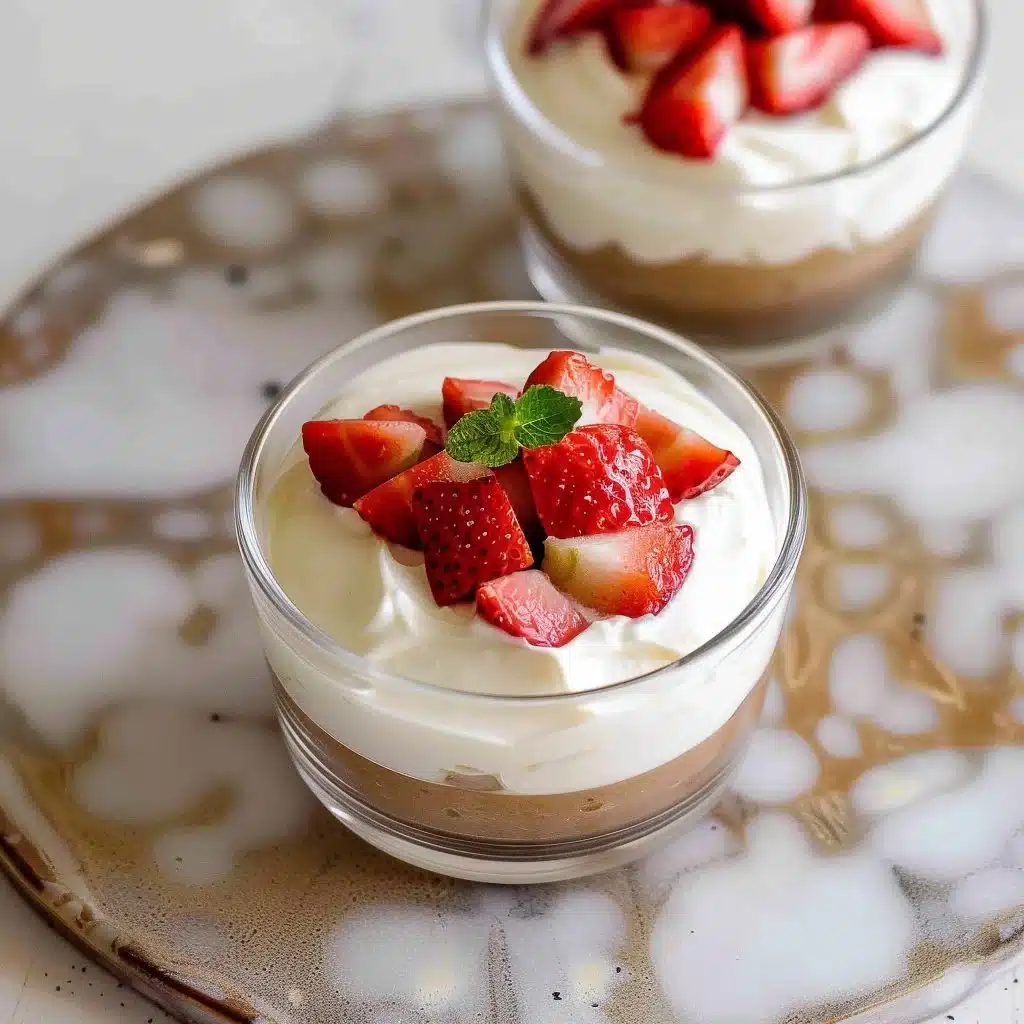
The transformation from raw ingredients to creamy, cohesive cheesecake cups is evident in both texture and structure. As the cream cheese and Greek yogurt blend together, their firm viscosity changes to a velvety consistency, slowly uniting with the honey and lemon juice. This conglomerate then contrasts with the crispness of the graham cracker crust, offering a distinctive textural interplay that mirrors chilled dairy desserts such as Creamy Greek Yogurt Cheesecake Cups that rely on controlled setting rather than baking.
Ingredient Integration and Texture Development
The action begins with the graham crackers, which, when crushed, reveal a dry, crumbly texture ideal for the crust. When combined with melted coconut oil and brown sugar, these ingredients undergo a key transformation. The fat from the coconut oil effectively binds the dry particles, creating a moistened mixture that molds seamlessly into shapes. The sugars dissolve slightly in the warmth, resulting in a cohesive crust that will harden as it cools, ensuring structural integrity.
Cream Cheese and Greek Yogurt Dynamics
As two blocks of cream cheese are worked into the mixture, they offer a rich, creamy body. The Greek yogurt adds a contrasting tanginess and moisture, which lightens the overall density of the filling. The emulsifying properties of both ingredients allow for a smooth blend when incorporated with honey, lemon juice, vanilla extract, and a pinch of salt. This interaction creates a filling that remains spoonable before chilling, similar in behavior to chilled yogurt-based desserts such as Decadent Greek Yogurt Chocolate Mousse, where structure develops gradually during refrigeration.
Sweetness and Acidity Balance
The introduction of honey serves a dual purpose: it contributes sweetness while complementing the acidity from lemon juice. The balance between sweet and sour remains restrained, allowing the tang of the yogurt to stay present. As the filling comes together, this interaction produces a controlled flavor profile that remains stable after chilling.
The Role of Heat in Culinary Creation
Heating is minimal in this recipe, restricted primarily to the melting of coconut oil. This brief exposure to warmth allows the crust ingredients to bind effectively without altering their dry character. Once cooled, the crust forms a stable base capable of supporting the denser cheesecake layer during refrigeration.
Cooling Process and Structural Influence
Once assembled, the cheesecake cups require refrigeration to transition from fluid to set. As temperature drops, fats within the cream cheese and yogurt firm, while moisture redistribution stabilizes the mixture. This cooling phase is essential to achieving clean layer definition and a cohesive spoonable texture.
Portioning and Serving Considerations
Each cheesecake cup contains a measured ratio of crust to filling, ensuring structural balance. Proper portioning prevents collapse at the edges and maintains a clear boundary between layers when served directly from refrigeration.
Storage Impact on Flavor and Texture
When stored under refrigeration, the cheesecake cups retain their structure for several days. Over time, minor moisture migration may soften the crust, though the filling remains stable. Airtight storage reduces surface drying and preserves textural consistency.
Freezing Dynamics for Extended Storage
Freezing alters the texture slightly by firming the filling more aggressively, though the primary structure remains intact. Thawing restores creaminess, while the crust may soften marginally. This method extends shelf life without significant degradation.
Preparation Steps
- Preheat the oven to 350°F (175°C).
- Crush graham crackers into fine crumbs using a food processor.
- Combine crumbs with melted coconut oil and brown sugar.
- Press the mixture firmly into the bottom of each cup.
- Bake crusts for 8–10 minutes, then cool completely.
- Beat cream cheese until smooth.
- Add Greek yogurt, honey, lemon juice, vanilla extract, and salt. Mix until combined.
- Spoon filling into cooled crusts and smooth the surface.
- Cover and refrigerate for 4–6 hours or overnight until set.
- Top with diced strawberries before serving, if desired.
Once fully chilled, the cheesecake cups maintain a stable structure with clear separation between crust and filling. The final texture remains cohesive and smooth, holding its form through storage and service while preserving the contrast between crisp base and creamy top.
Print
Greek Yogurt Cheesecake Cups
- Total Time: 285 minutes
- Yield: 6 servings 1x
- Diet: Vegetarian
Description
Deliciously creamy cheesecake cups made with Greek yogurt, cream cheese, and a graham cracker crust, perfect for any occasion.
Ingredients
- 1 cup graham cracker crumbs
- 4 tablespoons melted coconut oil
- 2 tablespoons light brown sugar
- 2 blocks cream cheese
- 1 cup Greek yogurt
- 1/2 cup honey
- 1/4 cup lemon juice
- 1 teaspoon vanilla extract
- 1/4 teaspoon salt
- Diced strawberries for topping (optional)
Instructions
- Preheat the oven to 350°F (175°C).
- In a food processor, crush the graham crackers until fine crumbs form.
- In a mixing bowl, combine the graham cracker crumbs, melted coconut oil, and light brown sugar until well mixed.
- Press the crumb mixture firmly into the bottom of each cup or dish.
- Bake the crusts in the preheated oven for 8-10 minutes until slightly golden and allow them to cool.
- In a large bowl, beat the cream cheese until smooth and creamy.
- Add the Greek yogurt, honey, lemon juice, vanilla extract, and salt to the cream cheese, mixing until thoroughly combined.
- Spoon the cheesecake filling into the cooled crusts, smoothing the top with a spatula.
- Cover the cups with plastic wrap and refrigerate for at least 4-6 hours, or overnight, until set.
- Before serving, top with diced strawberries if desired.
Notes
For best flavor, allow to chill overnight. Can be frozen for longer storage.
- Prep Time: 15 minutes
- Cook Time: 10 minutes
- Category: Dessert
- Method: Baking
- Cuisine: Greek
Nutrition
- Serving Size: 1 cup
- Calories: 250
- Sugar: 24g
- Sodium: 150mg
- Fat: 10g
- Saturated Fat: 6g
- Unsaturated Fat: 4g
- Trans Fat: 0g
- Carbohydrates: 34g
- Fiber: 1g
- Protein: 6g
- Cholesterol: 30mg