

The dates are softened in simmering water until they collapse into a glossy, thick paste that catches light across its surface. The oat mixture is turned into a coarse, sandy crumble when butter is distributed through the dry ingredients, with a reserved portion left loose for a fractured topping.
Date pulp consolidation during stovetop reduction
The two cups of chopped, pitted dates combined with one cup of water respond to steady medium heat by swelling, shedding surface sugars, and collapsing into a continuous mass over five to ten minutes. Cellular walls rupture as the water penetrates; soluble solids dissolve and coalesce into a viscous network that transitions from discrete fruit pieces to a homogeneous paste. The paste’s viscosity is governed by the ratio of soluble sugars to suspended fiber and the brief concentration that occurs as steaming water reduces; in this formula that balance yields a spreadable yet cohesive filling rather than a pourable syrup. The residual moisture after cooling remains entrained within the paste as a colloidal phase, where fructose and glucose form a glossy matrix that resists rapid drainage when layered onto the crust. This specific behavior—dates plus minimal water, heated briefly—produces a paste that holds together without mechanical binders, enabling it to sit between an oat crust and a loose oat topping without forcing migration of fines into the filling.
Oat-butter crumb formation and particle coating
When two cups of rolled oats are mixed with one cup of all-purpose flour and one cup packed brown sugar, then combined with one cup of softened butter, the mechanical action produces a heterogeneous crumb made of coated oat flakes and floury granules. Butter serves as both lubricant and partial binder: softened fat wraps starch and fiber particles, creating discrete aggregates rather than a continuous dough. The brown sugar contributes moisture and grainy pockets; its molasses content promotes slight cohesion among particles without dissolving fully at room temperature. Mixing until crumbly intentionally avoids gluten development from the flour and prevents full emulsification of the butter; the result is a sandy, friable mass that compacts under pressure but fractures easily. Reserving exactly one cup of this mixture preserves a higher proportion of free particles for a topping that remains loosely attached after baking, while the pressed remainder can form a denser base once compacted into the pan.
Crust compaction and early bake set
Pressing the remaining oat mixture into a greased 9×13-inch pan creates a compacted bed whose initial density determines how it responds during the ten-minute parbake at 350°F (175°C). Physical compaction reduces trapped air and increases contact between butter-coated particles, which accelerates heat conduction into the interior and promotes structural set within the short initial bake. During those ten minutes, butter melts and migrates, lubricating contact points while the exposed surface loses surface moisture and develops a faint crust. Flour and oats undergo partial gelatinization and protein coagulation at the heated interfaces, fixing the pressed structure so it resists collapse when the moist date paste is later introduced. The chosen pan size spreads mass thinly enough that a ten-minute exposure produces a supportive platform without deep browning, enabling the later baking step to complete color development rather than relying on an underbaked center.
Thermal contrast when spreading cooled filling
The cooled date filling and the slightly cooled parbaked crust create a thermal gradient at the moment of assembly that influences final texture. The date paste, set aside to cool after reduction, reclaims some viscosity as dissolved sugars slightly recrystallize at its surface; this makes it less fluid and easier to spread into a continuous layer without seeping into small voids in the crust. The crust, having been removed from the oven to cool slightly, retains residual warmth that softens its surface fats enough to adhere to the filling but not so hot as to liquefy the date paste. That interplay minimizes capillary suction from the date paste into the base; instead the paste sits atop the crust as an interfacial layer. Maintaining those relative temperatures prevents unwanted migration of moisture from the paste into the crust, preserving a defined filling layer rather than an absorbent, soggy intermix.
Loose topping retention versus compression
The reserved one cup of oat-butter mixture is intended as a non-compacted top layer and is sprinkled over the filling without pressing. Its particle size distribution—coated oat flakes interspersed with sugar-laden granules—creates a discontinuous surface where heat exposure during the final bake produces localized melting of brown sugar and partial coalescence of fat. Because the topping is not compressed, it bakes into islands of crispness separated by small gaps; the morphology of those islands depends on where fat pools and where sugar liquefies. The lack of pressure prevents the topping from adhering fully to the filling, which both preserves textural contrast and allows steam from the filling to vent laterally during the 25–30 minute bake. This reserved topping strategy is specific to the oat-to-butter ratio in this recipe: a different reserve fraction would change how much surface area is available to brown and how readily the topping fragments at the knife edge.
Maillard and sugar rearrangement during final bake
During the 25–30 minutes in a 350°F oven, the sugar components—both from packed brown sugar in the crumb and natural sugars in the dates—undergo thermal transitions that drive browning and a shift in surface crispness. The brown sugar’s molasses fraction contributes both color and moisture; under sustained heat it softens, migrates toward hotter surface zones, and catalyzes Maillard-like reactions with trace proteins from the flour and oats. The date paste, rich in reducing sugars, participates in surface darkening where it contacts the topping and where heat exposure is greatest. The final color gradient—golden topping with deeper caramelized seams—reflects localized sugar concentration and the time-temperature profile of the bake. Because the topping is loose, sugar melts can form thin glassy bridges between oat particles, which then harden on cooling to yield a crisp, shattering surface distinct from the more plastic date layer below.
In a related text on fruit-filled confection structure, a contrast in sugar matrices is examined in another recipe, as seen in Chocolate Date Hearts, where dense fruit fillings interact with different crust matrices.
Edge browning and moisture migration to pan sides
Edges in a 9×13 pan experience disproportionate heat transfer through the metal, accelerating both browning and moisture migration toward the pan boundary. The compacted base at the perimeter loses moisture faster than the center, causing tighter set and deeper color along the sides. Moisture that migrates laterally from the date paste will encounter that drier margin and either condense or be driven off as steam, depending on local temperatures; this creates a firmer, more caramelized edge and a slightly drier band adjacent to the pan. The structural contrast between center and edge is therefore a predictable outcome of the specific geometry and ingredient ratios—two cups oats and the given filling mass—used in this recipe. Managing edge behavior here is about accepting differential thermal gradients rather than isolating them, because the final cooling phase will redistribute residual moisture inward slightly as temperatures equalize.
Cooling-induced firming and sliceability
Once removed from the oven and allowed to cool completely, the date squares undergo a sequence of physical changes that transform them from a hot, plastic mass into discrete, sliceable pieces. The date paste loses heat and its viscosity increases as concentrated sugars form entangled networks; minor recrystallization of sugars and retrogradation of starches in the flour and oats contributes to firmness. The topping, cooled from a brittle glassy state where sugar bridges have hardened, stabilizes into a crisp fracturing layer. The cooling hold also allows any steam trapped between layers to escape and for equilibrium moisture distribution to be reached; this is why the instruction specifies complete cooling before slicing—the structure transitions that occur on standing are necessary for clean cuts and for reduction of smear. The finished squares present a layered cross-section: a compacted oat base, a dense fruit paste midlayer, and a crisp, irregular oat topping.
Scaling proportions for pan size and oat fraction
Adjustments in total mass relative to the 9×13 pan alter heat penetration and the balance between base compaction and topping crispness in predictable ways for this formula. Increasing batch quantity without increasing pan area thickens each layer and lengthens the time required for thermal center-set; thicker layers allow the date paste to retain more heat and moisture, which can delay topping browning and reduce edge crispness. Conversely, decreasing the oat fraction relative to the filling—by changing the reserve portion or pressing less—reduces structural integrity of the base and can permit the date paste to migrate into the crumb during baking. The recipe’s specific allocation—a pressed base from the majority of the oat mixture and one cup reserved for topping—creates a targeted thickness for each layer that harmonizes within the 25–30 minute final bake at 350°F; altering those proportions necessitates recalibration of bake time and may change whether the topping hardens or remains tacky on cooling.
Storage behavior and resting stability
After cooling, the assembled squares demonstrate storage behavior conditioned by the interaction of sugar activity and particle porosity in the oat components. The compact base, having lost more free water during baking, tends to remain dimensionally stable, while the topping’s exposed surface is more susceptible to absorbing ambient moisture if stored unprotected. The date paste, dense and sugar-rich, acts as an internal moisture reservoir and can slowly re-equilibrate water toward drier regions over extended storage, slightly softening adjacent crumb. This recipe’s balance of a relatively dry base, a moisture-rich middle, and a crisp topping yields a finished product that retains distinct textural zones for several days when kept in an airtight environment, as the dense sugar matrix slows microbial and textural breakdown while allowing slow humidity-driven adjustments that are typical for fruit-filled oat bars.
Preparation steps
- Prepare the date mixture by combining chopped dates and water in a saucepan. Heat over medium heat for 5-10 minutes until the dates soften and form a thick paste. Set aside to cool.
- In a large mixing bowl, combine oats, flour, brown sugar, baking soda, and salt. Add softened butter and mix until crumbly. Reserve 1 cup of this mixture for topping.
- Preheat your oven to 350°F (175°C). Grease a 9×13-inch baking pan. Press the remaining oat mixture evenly into the pan to form the crust. Bake for 10 minutes, then remove from the oven to cool slightly.
- Spread the cooled date filling evenly over the crust. Sprinkle the reserved oat mixture on top of the filling. Do not press down.
- Bake for 25-30 minutes until the top is golden and crispy. Remove from the oven and cool completely before slicing into squares.
The finished squares rest as defined layers: a compacted oat base, a dense date midlayer, and a fractured, crisp oat surface. After cooling completely the pieces maintain structural separation between those layers and present clean edges when sliced.
Print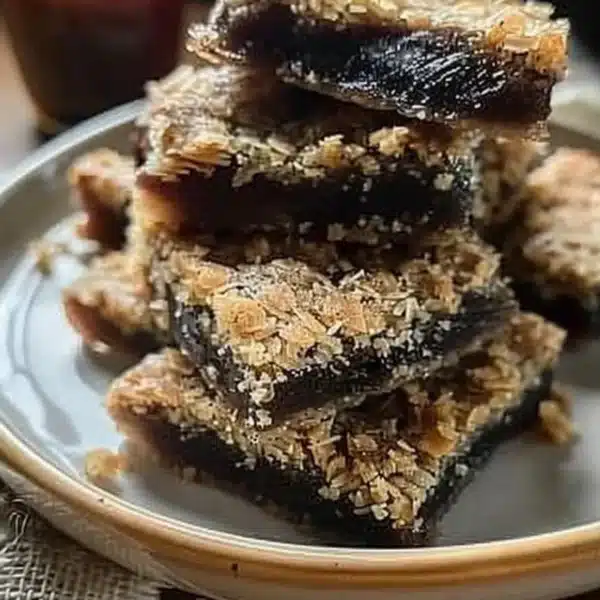
Gramma’s Date Squares
- Total Time: 55 minutes
- Yield: 16 squares 1x
- Diet: Vegetarian
Description
Delicious and chewy date squares with a crispy oat topping, perfect for snacking or dessert.
Ingredients
- 2 cups chopped, pitted dates
- 1 cup water
- 2 cups rolled oats
- 1 cup all-purpose flour
- 1 cup packed brown sugar
- 1 cup softened butter
- 1/2 tsp baking soda
- 1/4 tsp salt
Instructions
- In a saucepan, combine chopped dates and water. Heat over medium heat for 5-10 minutes until the dates soften and form a thick paste. Set aside to cool.
- In a mixing bowl, combine oats, flour, brown sugar, baking soda, and salt. Add softened butter and mix until crumbly. Reserve 1 cup of this mixture for topping.
- Preheat the oven to 350°F (175°C). Grease a 9×13-inch baking pan. Press the remaining oat mixture evenly into the pan to form the crust. Bake for 10 minutes, then remove from the oven to cool slightly.
- Spread the cooled date filling evenly over the crust. Sprinkle the reserved oat mixture on top of the filling without pressing down.
- Bake for 25-30 minutes until the top is golden and crispy. Remove from the oven and cool completely before slicing into squares.
Notes
Ensure to cool completely before slicing to maintain the structure of the squares.
- Prep Time: 15 minutes
- Cook Time: 40 minutes
- Category: Dessert
- Method: Baking
- Cuisine: American
Nutrition
- Serving Size: 1 square
- Calories: 220
- Sugar: 12g
- Sodium: 85mg
- Fat: 10g
- Saturated Fat: 6g
- Unsaturated Fat: 4g
- Trans Fat: 0g
- Carbohydrates: 34g
- Fiber: 3g
- Protein: 3g
- Cholesterol: 30mg