
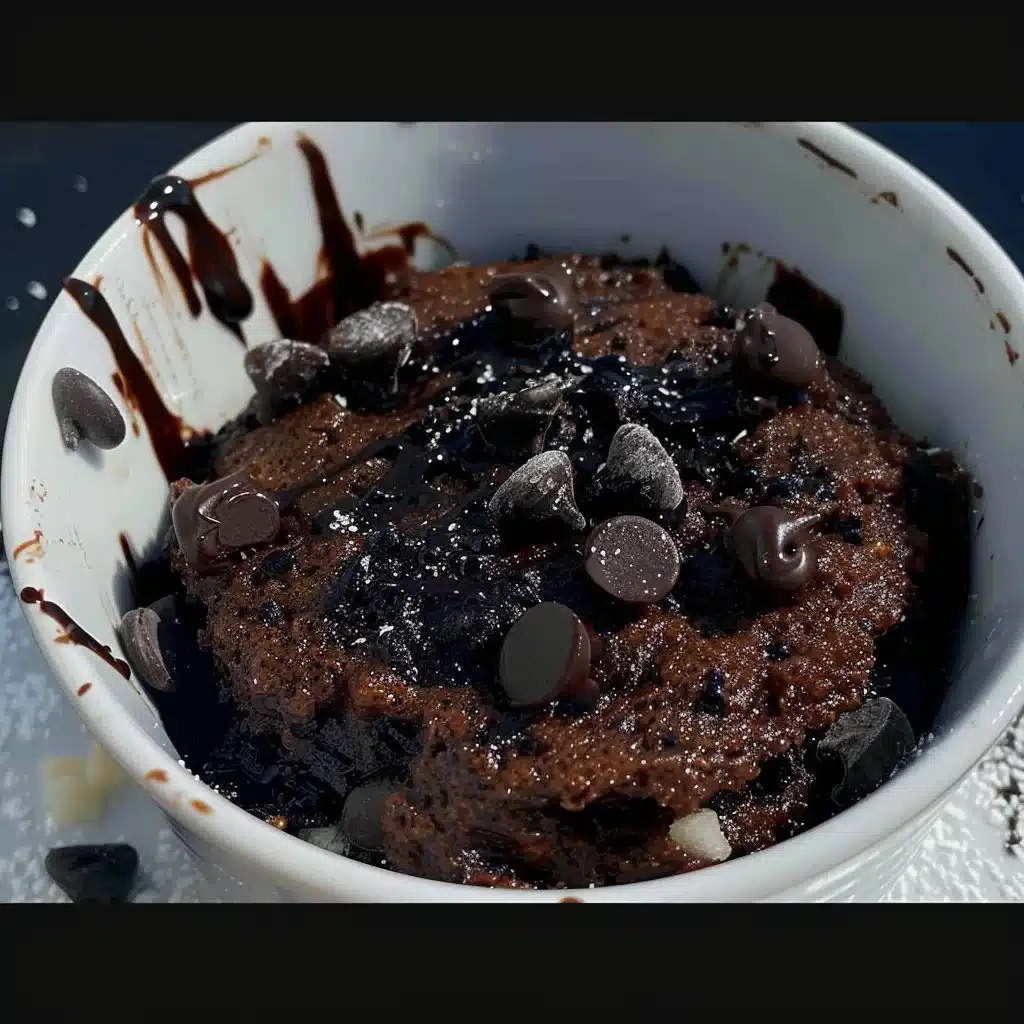
This cottage cheese microwave brownie begins with ingredients that feel ordinary until they are brought together with intention. Emily treats each one as a structural choice, not just a flavor, allowing the recipe to unfold from what those ingredients naturally want to do. The comfort comes from watching them shift quickly from separate parts into a unified batter.
Creaminess is the guiding thread. From the moment curds are blended smooth, the mixture takes on a fluid confidence that responds immediately to heat. The process is short, but the changes are distinct, moving from liquid to set with very little interruption.
What emerges is not about speed alone, but about how ingredients behave under pressure. The microwave simply reveals what has already been established in the bowl.

Cottage Cheese Microwave Brownie
- Total Time: 7 minutes
- Yield: 1 serving 1x
- Diet: Gluten Free, High Protein
Description
A quick and easy gluten-free brownie made with cottage cheese and topped with chocolate chips, providing high protein content.
Ingredients
- 1 egg
- 1/3 cup cottage cheese
- 3 tablespoons cocoa powder
- 3 tablespoons monk fruit sweetener
- Chocolate chips for topping
Instructions
- Lightly grease a small ramekin (or dish) with oil.
- In a high speed blender, add all ingredients except chocolate chips. Blend until smooth.
- Pour the brownie mixture into the dish and top with chocolate chips.
- Microwave for 1.5-2 minutes until desired firmness. Enjoy!
Notes
Placing chocolate chips after pouring concentrates heat at the batter surface and creates unique melt behavior.
- Prep Time: 5 minutes
- Cook Time: 2 minutes
- Category: Dessert
- Method: Microwave
- Cuisine: American
Nutrition
- Serving Size: 1 serving
- Calories: 230
- Sugar: 2g
- Sodium: 50mg
- Fat: 10g
- Saturated Fat: 4g
- Unsaturated Fat: 6g
- Trans Fat: 0g
- Carbohydrates: 26g
- Fiber: 3g
- Protein: 10g
- Cholesterol: 186mg
How the base ingredients establish structure
Cottage cheese and egg form the structural base of this brownie. When blended together, the curds collapse into a continuous liquid that the egg reinforces, creating a batter that can respond evenly to microwave energy.
This base determines how the brownie will set. Without visible curd pockets, the batter absorbs heat uniformly, allowing proteins to coagulate at a similar rate throughout the dish.

The result is a compact body that holds together cleanly once cooked, shaped by the smoothness achieved before heat is ever applied.
The role of cocoa as the main flavor builder
Cocoa powder is responsible for more than color here. Once dispersed into the blended dairy and egg, it becomes part of the continuous phase rather than sitting as dry specks.
This early dispersion allows cocoa to influence how heat moves through the batter. Its presence slightly thickens the mixture, slowing internal movement as the brownie sets.
Flavor develops alongside structure, with cocoa evenly distributed from center to surface.
Balancing sweetness and dairy richness
Sweetener enters the blend alongside cocoa, softening the sharpness of chocolate and rounding out the dairy base. Its viscosity changes how freely water moves within the batter.
This balance prevents the brownie from setting too rigidly. Sweetener keeps the interior supple even as proteins tighten under microwave heat.
The interaction between sweetness and dairy richness defines the final mouthfeel more than any single ingredient.
Stabilizers and thickening effects on mouthfeel
Egg proteins act as the primary stabilizer once heat is introduced. They coagulate rapidly in the microwave, locking the blended mixture into place.
Cottage cheese proteins reinforce this network, adding body without dryness. Together, they create a thickened matrix that feels cohesive rather than crumbly.

This stabilizing effect happens quickly, making timing essential to preserving softness.
Blending intensity and batter flow
The degree of blending determines how fluid the batter is when poured into the ramekin. A fully smooth blend flows easily, leveling itself before cooking begins.
This flow allows the surface to settle evenly, which affects how chocolate chips rest and melt later.
Insufficient blending leaves resistance in the batter, leading to uneven setting once heated.
Microwave heat and rapid setting
Microwave energy couples directly with the water and proteins in the batter, producing fast internal heating. Steam forms briefly and is quickly trapped by coagulating proteins.
This rapid sequence sets the brownie from the inside out, creating fine internal pores rather than large air pockets.
The short cook time preserves moisture while still producing a fully set interior.
Surface chocolate melt behavior
Chocolate chips placed on top respond differently to heat than the batter beneath them. They soften and partially melt before the interior has fully set.
This placement concentrates heat at the surface and creates a glossy layer that adheres as the brownie firms, a behavior similar to other set-cook formats such as cottage cheese protein brownies, where surface additions define the final texture.

The chips remain distinct, adding contrast without sinking.
Cooling and firmness stabilization
After microwaving, the brownie continues to change as it cools. Internal steam condenses, redistributing moisture back into the structure.
This brief cooling period finalizes firmness, reducing movement while preserving a soft center.
The brownie becomes easier to slice or spoon as the structure settles.
The final warm-set impression
Once rested, the brownie holds its shape with confidence. The interior remains creamy, supported by a smooth protein network.
The surface chocolate provides a gentle contrast, marking where heat first made contact.
What lingers is a sense of completeness, created quickly but grounded in how each ingredient was allowed to do its work.