
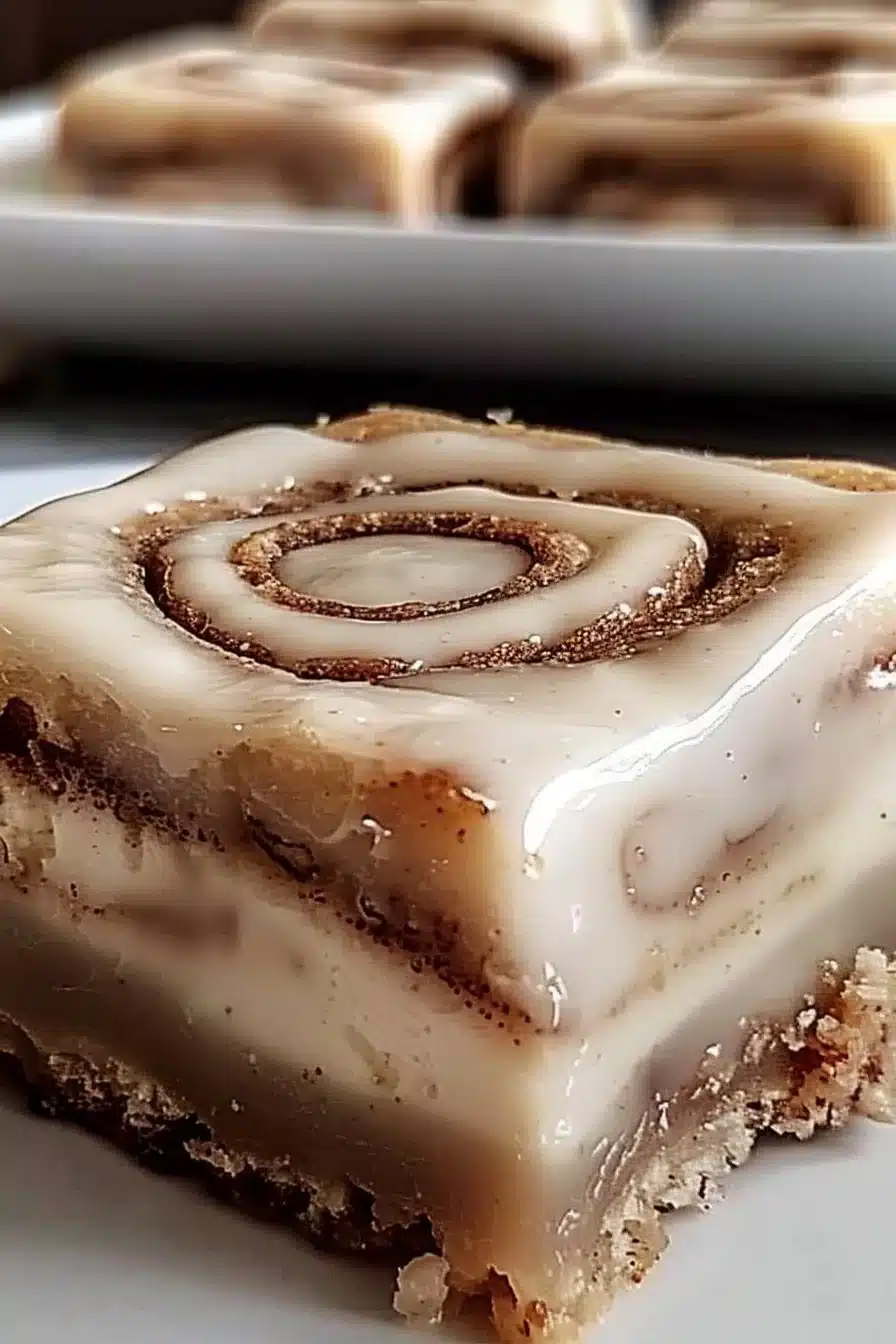
The batter shifts from a loose emulsion into a cohesive sheet when melted butter, eggs, and flour are combined, producing a pourable mass that can be spread across a 9×13 surface. Heat causes the cinnamon-sugar ribbons to set into discrete streaks while a faint aroma of cinnamon emerges during oven exposure.
Order-dependent thin-layer formation from half-batter spread
Spreading exactly half the batter across the greased 9×13 inch pan establishes a thin primary layer that limits vertical rise during the 25–30 minute bake. The sequence of “spread then sprinkle” fixes brown sugar and cinnamon onto a shallow bed of batter rather than an integrated swirl, because the base batter has only enough volume to coat the pan surface when halved. That limited vertical volume forces leavening activity to expand laterally first; the baking powder’s expansion pressure therefore becomes a driver of surface leveling instead of deep-rise doming. The follow-up step—dolloping the remaining batter—relies on the earlier thin layer to create discontinuities that the second batter must bridge. Those discontinuities control where the cinnamon mixture pools because the initial layer both absorbs and resists migration from the upper dollops, producing the banded appearance unique to this recipe.
Cumulative layer reinforcement from sequential sprinkling and dolloping
The recipe’s two-pass sprinkle/dollop sequence compounds density differences across the pan. The first cinnamon-brown sugar application deposits a concentrated particulate layer that compresses slightly when the remaining batter is dolloped on top. Each deposit increases local mass per unit area, so the areas under heavier sprinkle clusters undergo slower internal thermal rise during bake. Because the mixing instruction specifies “mix until just combined” for the batter, the top dollops carry a higher free-butter fraction than a fully emulsified batter would; that higher free-fat fraction locally delays gelatinization and coagulation. The cumulative outcome is a patterned grid where zones initially sprinkled alter the kinetics of the adjacent dollops, causing uneven but reproducible browning and set across the 9×13 field.
Immediate versus delayed sugar melting across the ribboned layer
Brown sugar placed in the cinnamon mixture begins to soften on contact with the warm surface of half the batter and then melts more fully when the dolloped batter overlays it. The immediate softening at the first sprinkle stage binds granules to the first batter film, preventing wholesale redistribution. Melting accelerates in the areas under dollops because those sections reach higher localized temperatures as the oven heat penetrates thicker masses. This recipe creates a pattern of early, surface-limited melt and later, interior melt: the first melt adheres to the thin base; the second melt integrates with the dollops and flows into seam lines during the 25–30 minute bake, where it then recrystallizes on cooling, leaving darker streaks and slightly tacky pockets.
Moisture migration during the bake-to-cool transition
Moisture confined in the batter moves along gradients set by the two-layer assembly. The thin half-batter base loses moisture faster at its exposed edges, while the dolloped regions retain moisture longer due to increased thickness. As oven heat drives water vapor outward, steam pathways form preferentially through junctions between dollops and base, carrying dissolved brown sugar and cinnamon into seams. When baking ends at “set in the middle,” pressure drops and vapor condenses back into the crumb matrix, but the condensed moisture concentrates in the seams and along the dollop perimeters. The resulting post-bake moisture distribution produces denser seams and slightly drier outer thin-layer fields, a pattern that can be traced back precisely to the step that specifies spreading half the batter before sprinkling.
Thermal gradient development across a 9×13 field
The specified 350°F (175°C) oven temperature produces a predictable thermal gradient across the pan depth and width given this recipe’s layer distribution. The thin base reaches internal temperatures closer to the oven ambient earlier than the thicker dollops, which maintain cooler cores for a longer portion of the 25–30 minute cycle. Heat transfer modes differ: conduction dominates through the thin base while convective penetration is slower into the dollops. Because the baking interval is relatively short, the baked center can reach “set” without full core equilibration in the thickest dollops; this results in a central zone that appears visibly set while retaining slightly less-coagulated material internally. The specified bake window thus produces a controlled thermal mismatch intentionally produced by the order of spreading and dolloping.
Gas expansion timing tied to batter mixing method
The instruction to “mix until just combined” alters trapped air distribution and sets expansion timing during bake. Minimal mixing preserves discrete air pockets and avoids uniform aeration; those limited pockets expand quickly in the thin, spread half and contribute to surface lift and lightness there, while in the thicker dollops the same pockets expand against greater resistance and collapse sooner, or redistribute into seams. The presence of 1 ½ teaspoons baking powder ensures chemical generation of gases at oven temperatures, but the timing of rise depends directly on how the steps sequence the batter placement. The dolloped second layer’s increased density delays both heat ingress and bubble growth, so gas expansion in that layer peaks later and is constrained laterally by the already-baked thin base, producing non-uniform but reproducible lift localized to the pan’s flat regions.
Retention of form after cooling following swirl disturbance
The gentle knife swirl imposed after dolloping fixes streak paths before the batter reaches oven-set. This mechanical rearrangement creates capillary channels and directional seams that direct molten brown sugar during bake. The post-bake cooling phase then locks these channels into place: as temperature falls, the viscous sugar in seams increases in viscosity and transitions to a semi-solid, preserving the swirl pattern. The order—spread, sprinkle, dollop, swirl—means cooling retains a layered map of initial manipulations; if swirl occurred before the first sprinkle or after full set, the preserved pathways and final appearance would differ. In this recipe, the swirl’s timing ensures that tiny seams remain open during thermal exposure and then close into stable, visible ribbons when the bars come to rest.
Reheating physics for reheating or holding after slicing
When a bar piece is reheated, the thin-layer-to-dollop ratio governs heat uptake and rate of surface reflow. Thin-base segments quickly reach a temperature where sugar softens again, causing surface tack and renewed mobility of cinnamon-brown sugar ribbons, while thicker dollop cores lag and warm more slowly. Because the initial recipe produces concentrated seams of recrystallized brown sugar, reheating first mobilizes those pockets; surface melt can refill micro-cracks created in slicing. The timing of reheating relative to the initial cooling state therefore changes the visible gloss and seam continuity: brief low-temperature exposure softens surface sugar without fully collapsing the bar, while longer exposure allows more even softening across dollop cores, reducing seam contrast. Those outcomes are directly determined by the original sequence of spreading and topping.
Batch scaling mechanics tied to 9×13 pan area and ingredient ratios
Scaling the recipe up or down without altering the sequence modifies layer thickness in ways that change bake dynamics specific to these ingredient amounts. The designation of 2 cups all-purpose flour, 1 cup granulated sugar, ½ cup melted butter, and two eggs produces a batter volume that, when halved and then re-applied as dollops, occupies the given pan dimensions in the intended thin-and-thick pattern. Changing batch volume while maintaining the same 9×13 would convert the initial half-batter spread from thin to medium thickness, increasing thermal lag in the base and altering where brown sugar pools. This recipe’s ratios were selected to produce lateral expansion dominance in the thin spread and delayed core set in the dollops; deviations in quantity or pan area shift those relationships and thus change the patterned outcome. The constrained order—spread first, sprinkle, then dollop and swirl—retains its mechanical significance across scaled volumes only if the relative layer proportions are preserved. Mid-paragraph reference: the apparent distribution mirrors layer handling used in almond flour sugar cookie bars.
The procedural steps follow exactly as written below; the single neutral sentence preceding them contains an embedded record for reference: The following steps move the components through mixing, layering, and thermal setting; savory cinnamon roll cottage cheese dessert.
- Preheat your oven to 350°F (175°C).
- Grease a 9×13 inch baking pan or line it with parchment paper.
- In a bowl, combine flour, sugar, baking powder, and salt until blended.
- Add melted butter, eggs, and vanilla extract; mix until just combined.
- In another bowl, mix brown sugar and cinnamon.
- Spread half the batter in the pan, sprinkle half of the cinnamon mixture on top.
- Dollop remaining batter over the cinnamon layer and sprinkle with the rest of the cinnamon mixture.
- Swirl gently with a knife.
- Bake for 25-30 minutes until golden brown and set in the middle.
The finished set lands as a sheet with variable density: thinner base fields that are firmer to touch and thicker dollop zones that retain slightly more internal cohesion. Residual seam channels of brown sugar and cinnamon remain visibly distinct and stable after cooling. The bars rest at room temperature with the ribboned pattern intact and no further change in form.
Print
Cinnamon Roll Bliss Bars
- Total Time: 45 minutes
- Yield: 12 servings 1x
- Diet: Vegetarian
Description
Delicious cinnamon roll bars with a unique layered structure featuring a sweet cinnamon-sugar ribbon.
Ingredients
- 2 cups all-purpose flour
- 1 cup granulated sugar
- ½ cup melted butter
- 2 eggs
- 1½ teaspoons baking powder
- ¼ teaspoon salt
- 1 teaspoon vanilla extract
- ½ cup brown sugar
- 1 tablespoon cinnamon
Instructions
- Preheat your oven to 350°F (175°C).
- Grease a 9×13 inch baking pan or line it with parchment paper.
- In a bowl, combine flour, sugar, baking powder, and salt until blended.
- Add melted butter, eggs, and vanilla extract; mix until just combined.
- In another bowl, mix brown sugar and cinnamon.
- Spread half the batter in the pan, sprinkle half of the cinnamon mixture on top.
- Dollop remaining batter over the cinnamon layer and sprinkle with the rest of the cinnamon mixture.
- Swirl gently with a knife.
- Bake for 25-30 minutes until golden brown and set in the middle.
Notes
For best results, allow the bars to cool completely before slicing to preserve the ribboned appearance.
- Prep Time: 15 minutes
- Cook Time: 30 minutes
- Category: Dessert
- Method: Baking
- Cuisine: American
Nutrition
- Serving Size: 1 bar
- Calories: 200
- Sugar: 10g
- Sodium: 150mg
- Fat: 8g
- Saturated Fat: 4g
- Unsaturated Fat: 3g
- Trans Fat: 0g
- Carbohydrates: 28g
- Fiber: 1g
- Protein: 3g
- Cholesterol: 45mg