
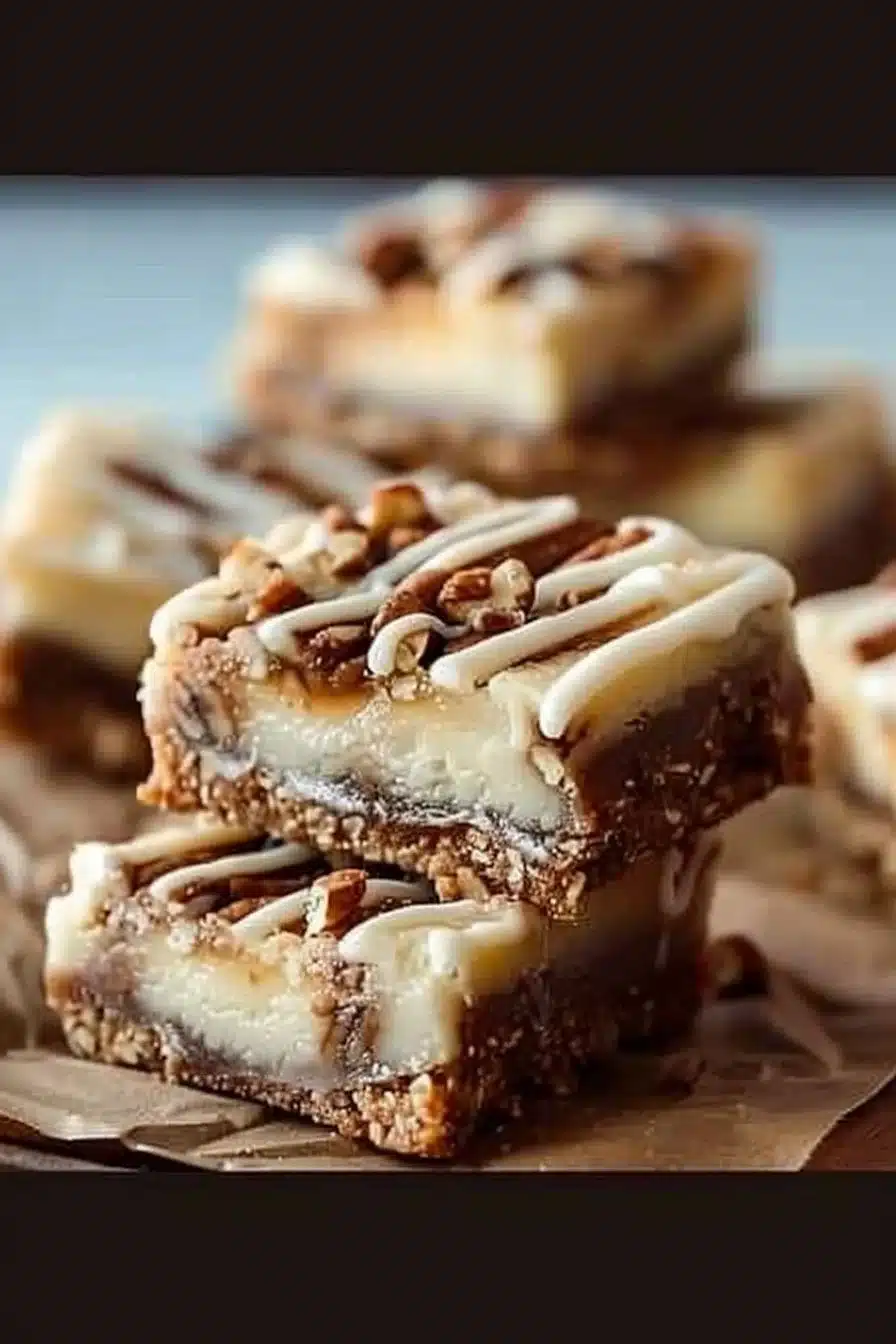
Creaming the softened butter and eggs with both brown and granulated sugars produces a glossy batter that coats flour granules and suspends cinnamon crystals within a cohesive mass. Oven heat inflates dissolved leaveners while surface sugars concentrate and brown, releasing a faint cinnamon aroma.
A shallow rectangular mass results from the ingredient list and the 9×13 inch pan specification, and a comparison with a savory variant appears in the same archive at savory cinnamon roll cottage cheese dessert, embedded within textual description.
Cohesive batter formation during butter-and-egg creaming
The single-portion creaming stage uses 1/2 cup unsalted butter, softened, with two large eggs and the combined sugars to produce a continuous wet phase that binds to the dry flour fraction. In this recipe the softened butter’s plasticity governs how quickly the wet ingredients emulsify; creaming until smooth disperses brown sugar granules throughout the fat phase, which then acts as a carrier for vanilla extract. That carrier function determines how evenly the later addition of 2 cups all-purpose flour and leaveners will be wetted when the wet and dry mixes are combined. The balance of granulated sugar and brown sugar in the creamed mix changes the batter’s flow at the moment it meets the dry bowl: higher brown sugar content produces smaller water pockets within the fat phase due to molasses, altering the batter thickness that must be spread into the 9×13 inch pan. The order of creaming sugars with butter and eggs first is the determinant of this cohesive state; if the sequence changes, the batter distribution measured by spreadability in step 5 will not match the intended layer delineation.
Dry-sugar matrix setting during initial whisk
Whisking 2 cups all-purpose flour with 1 cup brown sugar, 1/2 cup granulated sugar, 1 teaspoon baking powder, 1/2 teaspoon baking soda, 1/2 teaspoon salt, and 1 teaspoon ground cinnamon establishes a heterogeneous dry matrix that dictates leavening activation timing. In this recipe the leaveners remain inert until hydrated by the creamed butter-and-egg mixture; the pre-distribution of baking powder and baking soda across 2 cups of flour ensures that, when combined, carbon dioxide generation initiates uniformly rather than in localized pockets. The proportional sugar load embedded in the dry mix influences the rate at which the batter surface will caramelize during the 25–30 minute bake: discrete brown sugar granules retained in the dry whisk persist as micro-sites of concentrated sweetness beneath the top layer. Because the dry components are whisked before any wet contact, the subsequent single addition of the creamed wet mix defines a deterministic progression from unactivated powder to active crumb-rise, linked to the exact amounts listed.
Wet-to-dry consolidation timing when combining bowls
Combining the bowl of creamed butter, eggs, and vanilla with the large dry bowl is a single-consolidation event in this workflow. The instruction to “mix until just incorporated” controls the time window in which the leaveners and sodium bicarbonate begin reacting with the aqueous phase present in the eggs and softened butter. For this recipe, the consolidation timing is crucial because the batter is then split: half is spread into the prepared baking pan and the rest is reserved for topping. If mixing proceeds beyond the minimal incorporation point called for, the batter viscosity drops and the half-pour performed in step 5 will produce a thinner base layer, which alters the subsequent cinnamon sugar layer’s relative position and the final cross-section. The sequencing — creaming then combining then splitting — locks in the batter’s internal gas distribution and determines whether the cinnamon sugar layer will remain distinct or be partially subsumed during the final layer spread.
Layer delineation from half-pour then cinnamon sugar scatter
Spreading half of the batter into the prepared 9×13 inch pan before adding the cinnamon sugar creates a physical interface that the recipe exploits. The recipe’s precise half-portion step produces a base thickness defined by the total batter volume derived from the listed ingredients. Sprinkling a cinnamon-sugar mixture—specified here as 1/4 cup sugar with 1 tablespoon cinnamon—over that base produces a discontinuous topography of dry crystals resting on a semi-fluid foundation. This discontinuity resists immediate blending when the remaining batter is spread on top, so the sequence of base pour, dry scatter, and top pour yields a layered assembly rather than a uniform swirl. The order matters: if the scatter occurs on a thicker base resulting from overmixing or a full-batch pour, the cinnamon sugar will sink differently during the 25–30 minute bake and the visible bands in the finished bars will compress or spread. The recipe’s stated portioning enforces a reproducible layer geometry in this specific pan and with these ingredient masses.
Surface browning and internal expansion over the 25–30 minute bake
The bake interval of 25–30 minutes in a 350°F (175°C) oven drives concurrent surface browning and internal expansion processes. The combination of 1 teaspoon baking powder and 1/2 teaspoon baking soda, dispersed across 2 cups of flour and activated upon hydration, generates gas that grows within the batter’s liquid-continuous phase; gas expansion elevates the top surface while the thin sugar-laden surface films at the pan-air interface concentrate and undergo Maillard and caramelization reactions. The specified time window balances sufficient internal set — indicated by a toothpick coming out clean — against excessive surface darkening. In this formulation, the brown sugar fraction contributes to earlier localized browning at micro-sites, creating a nonuniform color that corresponds directly to the original sugar distribution from the earlier whisk and the cinnamon-sugar scatter. The bake duration also determines the degree to which the cinnamon sugar layer diffuses vertically; shorter times limit diffusion, while the upper end of the range allows more migration and surface integration.
Cinnamon sugar migration between layers during the bake
The presence of a middle layer of 1 tablespoon cinnamon mixed with 1/4 cup sugar establishes a concentration gradient between that dry film and the adjacent wet batter layers. During the 25–30 minute bake, steam generated from the eggs and residual water in the sugars creates convective microcurrents that carry dissolved brown sugar and cinnamon soluble fractions into neighboring pockets. In this recipe the limited vertical distance between the base and top batter layers across a 9×13 inch pan means that migration is constrained by the original layer thickness set in step 5 and step 7. The cinnamon’s particulate fraction remains largely localized, but soluble components from the 1/4 cup sugar dissolve and redistribute into the surrounding batter, altering local viscosity and the immediate browning potential in those zones. The sequence—pour base, scatter dry, pour top—defines the initial gradient; the bake’s thermal and vapor flux then modifies that gradient but cannot erase the banding established by the original assembly.
Glaze adherence after cooling and the effect of dilution ratio
The glaze specified — 1/2 cup powdered sugar, 1 tablespoon milk, and 1/2 teaspoon vanilla extract — sets a solid-to-liquid ratio that affects how it spreads and adheres to the cooled surface. Applied only after the bars have cooled, the glaze’s small milk fraction produces a viscous, opaque film that settles into the topography created by the bake’s surface cracking and cinnamon-sugar pockets. In this recipe the glaze will cling preferentially to slightly concave zones where powdered sugar finds micro-anchors; the vanilla extract contributes aromatic volatiles but no significant binding strength. The dilution ratio of powdered sugar to milk determines the glaze’s sagging window: with 1 tablespoon milk the glaze is fluid enough to drizzle yet thick enough to form a thin skin when set. The timing is consequential — applying this glaze before adequate cooling increases the glaze’s penetration into the crumb and increases local softening, whereas waiting for cooling preserves the glazing as a discrete surface film consistent with the recipe’s intended finish.
Cooling-set period that halts residual expansion
Allowing the baked slab to cool before glazing and cutting establishes a final dimensional freeze for the bars. Residual internal steam and trapped gases continue minor expansion for a short period immediately after removal from the 350°F (175°C) environment; as the slab cools, the batter matrix solidifies and those gases contract, leaving a stable crumb distribution. In this recipe the specified cut-after-cool sequence prevents smear of the freshly applied glaze and reduces tearing of the top layer when squares are removed. The 9×13 inch geometry and the initial batter depth determine the thermal mass and thus the cooling rate; larger thermal mass would extend the period of residual movement, but with the given ingredient quantities the resting time before cutting is sufficient to arrest appreciable dimensional change. The ordered sequence — bake, cool, glaze, cool further, cut — is necessary to obtain an intact pattern of cinnamon bands and a coherent bar edge.
Reheat and hold behavior for preset bar geometry
When bars are reheated after storage, the glazes and sugar concentrations respond differently than the crumb. Reheating mobilizes surface sugars faster than internal starchy components, so the external sheen can become tacky while the interior regains slight pliancy. In this recipe the original glaze composition with 1 tablespoon milk and 1/2 cup powdered sugar will soften under brief reheating and then re-set upon cooling, but the repeated cycle can reduce the visual definition of the cinnamon bands due to minor migration of dissolved sugars. The 9×13 inch pan-derived geometry produces bars with uniform thickness that respond predictably to short reheating intervals; the sequence of thaw (if frozen), brief gentle heat, then a short rest will return the bars to a similar cutting consistency without altering the positioned cinnamon-sugar layer unless heating is prolonged. The recipe’s initial assembly and glaze composition fix the bars’ reheat behavior for the specified portions.
Scale-up constraints when increasing to larger batches
Increasing this recipe beyond the baseline quantities in a single 9×13 inch pan changes several time-sensitive relationships. Doubling ingredients alters batter volume and layer thickness, which in turn shifts the interaction window for the cinnamon-sugar scatter and the precise 25–30 minute bake range. For example, doubling the 2 cups all-purpose flour and 1 cup brown sugar requires a pan change or bake time adjustment because the same thermal gradient will penetrate thicker batter more slowly, allowing extended migration of the cinnamon-sugar mixture and deeper browning before the center reaches the toothpick-clean endpoint. The two-leavener combination (1 teaspoon baking powder and 1/2 teaspoon baking soda) does not scale linearly in terms of gas release timing when mixed into larger volumes; distribution uniformity from the initial whisk step becomes a limiting factor. Therefore, any batch scaling modifies the sequential constraints established by the original steps and produces different final banding and crumb characteristics under otherwise identical heat treatment.
Preparation steps
The following numbered steps reproduce the exact sequence required by this recipe.
- Preheat the oven to 350°F (175°C) and grease a 9×13 inch baking pan.
- In a large bowl, whisk together the flour, brown sugar, granulated sugar, baking powder, baking soda, salt, and cinnamon.
- In another bowl, cream the softened butter and eggs together until smooth. Mix in the vanilla extract.
- Combine the wet ingredients into the dry ingredients and mix until just incorporated.
- Spread half of the batter into the prepared baking pan.
- In a small bowl, mix together some cinnamon sugar (1/4 cup sugar with 1 tablespoon cinnamon) and sprinkle evenly over the batter.
- Spread the remaining batter on top.
- Bake for 25-30 minutes or until a toothpick comes out clean.
- For the glaze, mix the powdered sugar, milk, and vanilla extract until smooth and drizzle it over the cooled bars.
- Cut into squares and serve.
Mid-article cross-references within the archive appear without framing, including an adjacent-category example embedded here: almond flour sugar cookie bars within an operational description.
The tray set cools to ambient temperature and the glaze sets into a thin film across the top. The cut squares rest on a firm, settled crumb with visible cinnamon bands and a stable surface sheen.
Print
Cinnamon Roll Bliss Bars
- Total Time: 45 minutes
- Yield: 12 servings 1x
- Diet: Vegetarian
Description
Delicious cinnamon roll inspired bliss bars, layered with a cinnamon-sugar filling and topped with a sweet glaze.
Ingredients
- 1/2 cup unsalted butter, softened
- 2 large eggs
- 1 cup brown sugar
- 1/2 cup granulated sugar
- 2 cups all-purpose flour
- 1 teaspoon baking powder
- 1/2 teaspoon baking soda
- 1/2 teaspoon salt
- 1 teaspoon ground cinnamon
- 1 teaspoon vanilla extract
- 1/4 cup sugar (for cinnamon sugar)
- 1 tablespoon cinnamon (for cinnamon sugar)
- 1/2 cup powdered sugar (for glaze)
- 1 tablespoon milk (for glaze)
- 1/2 teaspoon vanilla extract (for glaze)
Instructions
- Preheat the oven to 350°F (175°C) and grease a 9×13 inch baking pan.
- In a large bowl, whisk together the flour, brown sugar, granulated sugar, baking powder, baking soda, salt, and cinnamon.
- In another bowl, cream the softened butter and eggs together until smooth. Mix in the vanilla extract.
- Combine the wet ingredients into the dry ingredients and mix until just incorporated.
- Spread half of the batter into the prepared baking pan.
- In a small bowl, mix together the cinnamon sugar (1/4 cup sugar with 1 tablespoon cinnamon) and sprinkle evenly over the batter.
- Spread the remaining batter on top.
- Bake for 25-30 minutes or until a toothpick comes out clean.
- For the glaze, mix the powdered sugar, milk, and vanilla extract until smooth and drizzle it over the cooled bars.
- Cut into squares and serve.
Notes
Allow the bars to cool before applying glaze for the best results.
- Prep Time: 15 minutes
- Cook Time: 30 minutes
- Category: Dessert
- Method: Baking
- Cuisine: American
Nutrition
- Serving Size: 1 square
- Calories: 250
- Sugar: 20g
- Sodium: 150mg
- Fat: 10g
- Saturated Fat: 5g
- Unsaturated Fat: 4g
- Trans Fat: 0g
- Carbohydrates: 35g
- Fiber: 1g
- Protein: 3g
- Cholesterol: 30mg