
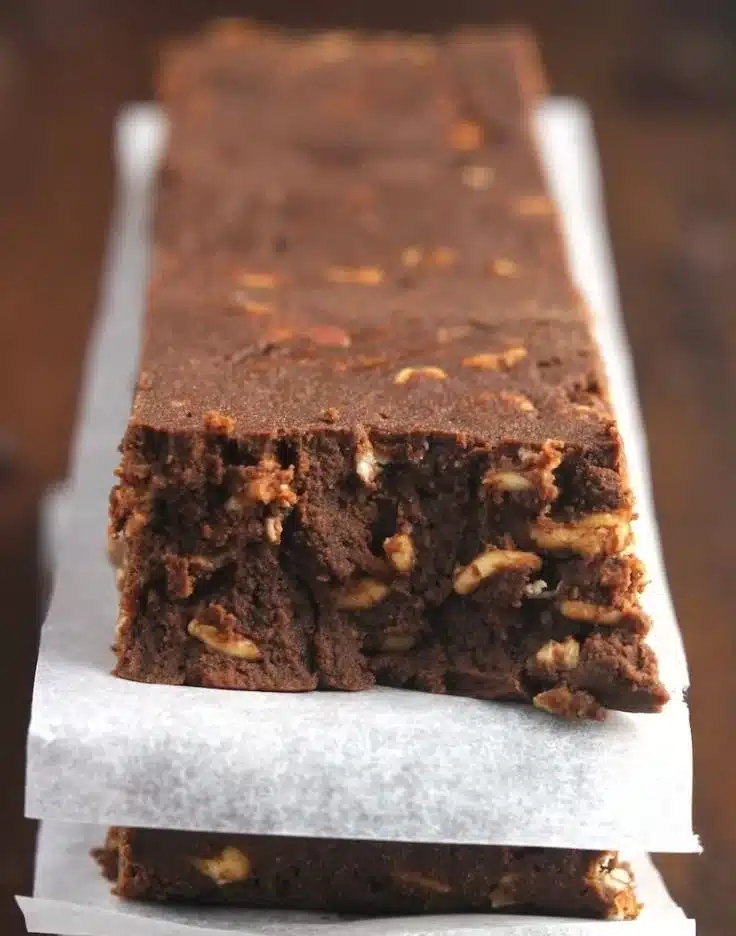
These bars are assembled through mixing, pressing, and chilling rather than baking. Dry ingredients are combined with nut butter and liquid sweetener to form a dense, cohesive mixture that firms in the refrigerator. Once set, the slab slices cleanly into compact bars with a uniform interior and defined edges. The process relies on controlled ratios and compression to achieve consistent structure with minimal equipment.
Base composition and mixture behavior
The mixture begins with protein powder, almond flour, cocoa powder, and salt combined in a single bowl. Blending the dry ingredients first ensures even distribution before any moisture is added. This step prevents clumping and allows the mixture to accept the wet ingredients uniformly.
Almond flour contributes body without elasticity, keeping the bars compact rather than springy. Cocoa powder disperses evenly at this stage, creating a consistent chocolate profile throughout the base.
Nut butter as the binding element
Nut butter is added next, forming the primary binder. As it is worked into the dry ingredients, it coats each component evenly, transforming the mixture from powdery to cohesive. This binding behavior allows the bars to be pressed firmly without cracking or separating once chilled.
This same binding logic appears in other pressed, chilled recipes such as no-bake protein bars, where structure is achieved through fat and compression rather than heat.
Liquid integration and texture control
Almond milk and liquid sweetener are added gradually, loosening the mixture just enough to form a thick, moldable dough. The liquid ingredients distribute moisture evenly, preventing dry pockets while maintaining firmness. Mixing continues only until the dough becomes uniform, avoiding overworking.
Vanilla extract integrates at this stage, dispersing evenly and rounding out the cocoa flavor without altering structure.
Compression and pan behavior
The finished mixture is transferred to a parchment-lined 8×8-inch pan and pressed firmly into an even layer. Compression is essential: pressing removes air pockets and ensures uniform thickness across the slab. Proper pressure produces bars that hold together cleanly and slice evenly once set.
This pan-based method mirrors other compact chocolate formats like peanut butter protein brownies, where controlled thickness supports clean cuts.
Chilling and set development
Refrigeration replaces baking as the setting mechanism. As the bars chill, the nut butter firms and the almond flour finishes absorbing moisture. This transition locks the structure in place without hardening the interior. The bars become stable enough to lift and cut while remaining dense and cohesive.
Cutting and edge definition
Once fully chilled, the slab is lifted from the pan using the parchment overhang. A sharp knife produces straight edges and evenly sized bars. Cleaning the blade between cuts improves definition and prevents dragging through the surface.
Texture after setting
After setting, the bars maintain a compact interior with a slight chew. The structure remains consistent from edge to center, and the bars do not crumble when handled. They can be stacked or packaged without losing shape.
Storage behavior
Stored in an airtight container in the refrigerator, the bars retain their structure for several days. Freezing further firms the mixture without changing its internal consistency. Brief thawing restores the original texture, making advance preparation practical.
Context for no-bake chocolate bars
No-bake chocolate bars depend on balance between dry ingredients, binders, and chilling time. Almond flour and nut butter replace flour and baking as the primary structural elements. General explanations of this pressed, no-bake bar approach can be found in neutral ingredient references such as those provided by MyProtein:
https://www.myprotein.com/thezone/recipe/no-bake-protein-bars/
The preparation follows a direct sequence.
- In a mixing bowl, combine the protein powder, almond flour, cocoa powder, and salt.
- Add the nut butter, almond milk, liquid sweetener, and vanilla extract.
- Mix until a thick, uniform dough forms.
- Press the mixture firmly into a parchment-lined 8×8-inch pan.
- Refrigerate for at least 30 minutes, until firm.
- Cut into bars and serve.

Chocolate Protein Bars
- Total Time: 45 minutes
- Yield: 8 servings 1x
- Diet: Vegan
Description
These no-bake chocolate protein bars are dense, chewy, and packed with flavor, perfect for a post-workout snack or a healthy treat.
Ingredients
- 1 cup protein powder
- 1 cup almond flour
- 1/2 cup cocoa powder
- 1/4 teaspoon salt
- 1/2 cup nut butter
- 1/4 cup almond milk
- 1/4 cup liquid sweetener
- 1 teaspoon vanilla extract
Instructions
- In a mixing bowl, combine the protein powder, almond flour, cocoa powder, and salt.
- Add the nut butter, almond milk, liquid sweetener, and vanilla extract.
- Mix until a thick, uniform dough forms.
- Press the mixture firmly into a parchment-lined 8×8-inch pan.
- Refrigerate for at least 30 minutes, until firm.
- Cut into bars and serve.
Notes
Store in an airtight container in the refrigerator for up to a week or freeze for longer storage.
- Prep Time: 15 minutes
- Cook Time: 0 minutes
- Category: Snack
- Method: Chilling
- Cuisine: American
Nutrition
- Serving Size: 1 bar
- Calories: 210
- Sugar: 8g
- Sodium: 150mg
- Fat: 12g
- Saturated Fat: 2g
- Unsaturated Fat: 10g
- Trans Fat: 0g
- Carbohydrates: 22g
- Fiber: 5g
- Protein: 10g
- Cholesterol: 0mg