
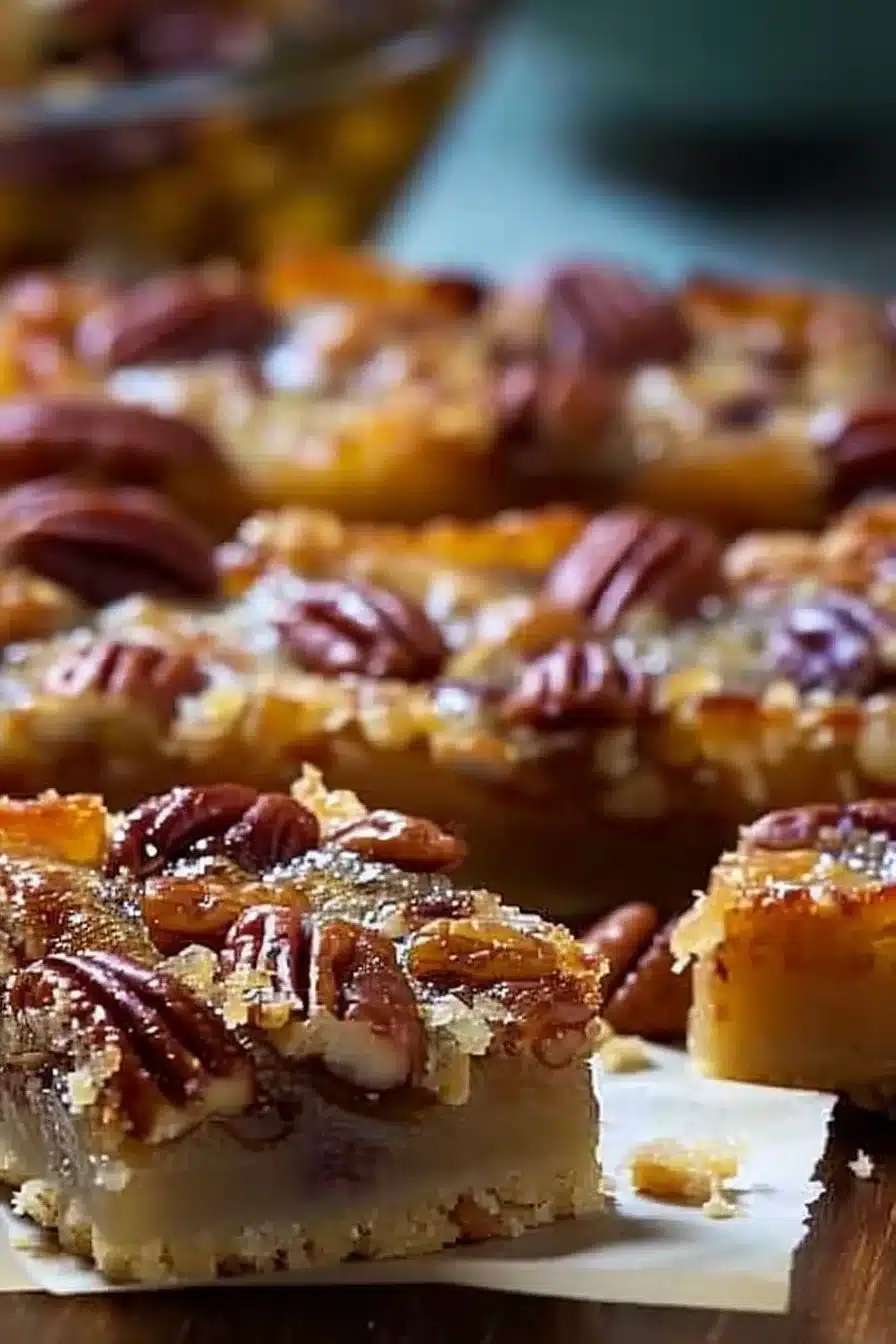
A dense, pale dough compacts under the palm into an even sheet that holds its shape against the parchment. The glossy brown-sugar and egg filling flattens into a shallow pool over that sheet, then tightens and dulls as it bakes into a cohesive bar, with a single contrast of chopped pecans interrupting the sheen and bite — compare this bar’s surface tension to easy baked berry oatmeal squares for a sense of relative gloss and grain.
Crust particle cohesion under manual pressing
The crust in this formula is a pressed, shortcrust-like foundation made from 2 cups all-purpose flour, 1 cup unsalted butter (softened), and 1/2 cup confectioners sugar. With those ratios, particle contact is the dominant structural factor: the flour provides the granular skeleton; the softened butter fills interstices and creates film continuity; the confectioners sugar, very finely milled, reduces friction between flour particles and produces a smoother, more compactable mass than granulated sugar would. When pressed into the 9×13-inch pan, this mixture forms a near-continuous plane rather than a loose bed of crumbs because softened butter overlaps multiple flour particles without fully wetting them. The pressure applied during pressing determines the initial density — firm, even pressure creates fewer voids and a closer bond between particles, which reduces post-bake sag of the filling and increases the apparent crispness at the perimeter.
Melting behavior of the butter within the base during the bake
At 350°F (175°C) the softened butter in the crust melts before the flour network has time to gelatinize or set. In this specific assembly, that early melt creates transient pockets of fat that redistribute under capillary and gravitational forces. The parchment-lined 9×13 surface provides a flat heat sink; as butter liquefies, it migrates to lower points in the dough and pools slightly against the pan, encouraging browning where fat concentration is higher. Because the crust started as softened rather than creamed butter, there is minimal entrained air; the result is a compacted layer that browns and crisps rather than rises. The confectioners sugar moderates surface hydration during this phase because its fine particles attract moisture from the filling by surface contact, keeping the interface between crust and filling relatively thin and enabling a sharper textural contrast.
Brown sugar and pecan matrix formation in the filling
The filling is a simple three-component matrix dominated by 1 cup light brown sugar, 3 eggs, and 1 cup chopped pecans. As the eggs heat, they denature and then coagulate, but the brown sugar’s molasses content creates a syrupy phase that persists through much of the bake. That syrup interacts with the coagulating egg proteins to produce a glossy, semi-rigid sheet when cooled. The pecans act both as inclusions and as localized nucleation sites for caramelization; their chopped surfaces increase surface area and encourage the brown sugar to form thin caramel films around nut fragments. Because brown sugar carries hygroscopic molasses, it stabilizes moisture at the sugar-protein interface, which slows the rate at which the center loses water compared with a filling that used granulated sugar alone. In this recipe, that balance yields an interior that is set but still dense rather than dry and crumbly.
Egg protein coagulation and center setting specific to these proportions
Three whole eggs in this volume produce a moderate protein network that sets the filling without creating a sponge. At 350°F and the roughly 40-minute bake time specified, the eggs coagulate into a continuous matrix that traps the viscous brown-sugar phase. The ratio of eggs to sugar here is lower than in custard-forward bars, so the protein network is comparatively coarse: proteins form thicker strands and bind more strongly to the viscous sugar than to free water. That thicker network explains why the center becomes “set” rather than custardy; the gel point is reached when enough proteins have reorganized to resist shear and the filling loses its gloss. Because the recipe pairs these eggs with a high-sugar, molasses-bearing component, the coagulation temperature and the visual cue of a dulling surface are distinct to this mixture and not directly transferable to fillings with different egg-to-sugar ratios.
Pecan placement and the resulting textural interrupts
The recipe specifies 1 cup pecans, chopped, folded into the brown-sugar-and-egg mixture and poured over the crust. In practice the chopped pecans sink only partially into the viscous filling; they remain as suspended inclusions that protrude across the surface once the surface tension relaxes. The size of the chop matters here because the specified volume produces a pecan-to-bite frequency that defines how often a crunchy element is encountered in a given square from a 9×13 pan. Those pecans create discontinuities in the filling’s continuity: heat transfer is locally altered where a nut piece contacts the crust; caramelization is more intense around exposed nut surfaces; and the mechanical response during cutting is punctuated by the solid-nut inclusions that resist knife shear. The contrast between the dense protein-sugar matrix and the brittle nut fragments is therefore a precise consequence of the one-cup measurement and the chopping coarseness indicated by “chopped” in the ingredient list — similar contrasts can be observed in other bar formats such as cozy morning treat, but the frequency and force of the interrupts are unique here.
Edge browning and thermal gradient across a 9×13 tray
A 9×13-inch baking dish produces a predictable thermal field at 350°F. Heat conducts from the metal (or glass, if used) into the crust and filling, but the edges of the dish always reach effective baking temperature sooner than the center. In this recipe the thin crust layer accelerates edge browning because the butter concentration at the perimeter — assisted by pressing and the pan’s contact — creates a localized high-fat zone. The brown sugar in the filling caramelizes first near the edges where moisture loss is fastest, so the combination of caramelization and Maillard reactions on nut fragments produces a golden ring before the center demonstrates visual set. The prescribed timing of “about 40 minutes or until the edges are golden and the center is set” maps directly to this gradient: the edge becomes a crisp reference while the center relies on the egg-sugar coagulation to signal readiness.
Center firmness, residual moisture, and cooling-related consolidation
Once removed from the oven, the bars continue to move through a short thermal window where residual heat drives moisture from the interior toward the surface and into the crust. Because the crust was compacted and contains a significant fat fraction, it resists rehydration even as water migrates outward; this keeps the crust texturally distinct after cooling. Allowing the pecan squares to cool completely before cutting into squares and serving is not merely a serving preference — it permits the internal sugar-protein matrix to crystallize slightly and redistribute water so that cuts hold cleanly. In this specific recipe, the balance between viscous brown sugar and coagulated egg means the filling will firm on cooling rather than remaining elastic; cutting too soon risks smearing and a loss of sharp edges because the gel point has not been fully re-established.
Execution sequence
The following numbered steps reproduce the assembly and bake order exactly as provided.
- Preheat oven to 350°F (175°C) and line a 9×13-inch baking dish with parchment paper.
- In a mixing bowl, combine flour, butter, and confectioners sugar to form the crust mixture. Press the mixture into the bottom of the prepared baking dish.
- In another bowl, mix together pecans, brown sugar, eggs, and vanilla extract for the filling. Pour the filling over the crust.
- Bake in the preheated oven for about 40 minutes or until the edges are golden and the center is set.
- Allow the pecan squares to cool completely before cutting into squares and serving.
- Optional: Dust with powdered sugar before serving.
Portioning mechanics and short-term surface finish
Cutting into squares from a cooled 9×13 slab requires attention to knife geometry and motion because the filling is dense and contains solid inclusions. For this composition, vertical pressure with minimal lateral shearing produces the cleanest edges: a sharp blade entering and exiting in a single motion slices the coagulated protein-sugar sheet without compressing the crust. The optional dusting of powdered sugar is a superficial finish that sits on the cooled surface and does not interact chemically with the filling; it highlights fracture lines and slightly softens perceived edge crispness by introducing a fine, soluble powder that dissolves within seconds on warm spots. For short-term storage, the powdered sugar can absorb ambient moisture and lose its opacity, so its visual role is ephemeral unless the squares remain fully cooled and dry before enclosure.
Closing
After cooling, the bars present a compact crust layer over a dense, slightly glossy interior punctuated by chopped pecans. The final state is a firm, sliceable slab with a clear edge-to-center gradient in color and texture.
Print
Buttery Pecan Squares
- Total Time: 55 minutes
- Yield: 16 servings 1x
- Diet: Vegetarian
Description
Delicious buttery pecan squares with a rich filling and a crumbly crust, perfect for dessert or snacks.
Ingredients
- 2 cups all-purpose flour
- 1 cup unsalted butter, softened
- 1/2 cup confectioners sugar
- 1 cup light brown sugar
- 3 large eggs
- 1 cup chopped pecans
- 1 teaspoon vanilla extract
Instructions
- Preheat oven to 350°F (175°C) and line a 9×13-inch baking dish with parchment paper.
- In a mixing bowl, combine flour, butter, and confectioners sugar to form the crust mixture. Press the mixture into the bottom of the prepared baking dish.
- In another bowl, mix together pecans, brown sugar, eggs, and vanilla extract for the filling. Pour the filling over the crust.
- Bake in the preheated oven for about 40 minutes or until the edges are golden and the center is set.
- Allow the pecan squares to cool completely before cutting into squares and serving.
- Optional: Dust with powdered sugar before serving.
Notes
For best results, allow the pecan squares to cool completely before cutting to avoid smearing.
- Prep Time: 15 minutes
- Cook Time: 40 minutes
- Category: Dessert
- Method: Baking
- Cuisine: American
Nutrition
- Serving Size: 1 square
- Calories: 250
- Sugar: 15g
- Sodium: 150mg
- Fat: 15g
- Saturated Fat: 6g
- Unsaturated Fat: 8g
- Trans Fat: 0g
- Carbohydrates: 30g
- Fiber: 1g
- Protein: 4g
- Cholesterol: 40mg